Small Garden Storage Ideas That Stay Out of Sight
Where to keep tools, bins, the hose and cushions in a small yard so they stop taking over the view, with simple rules for placing and disguising each piece of storage.
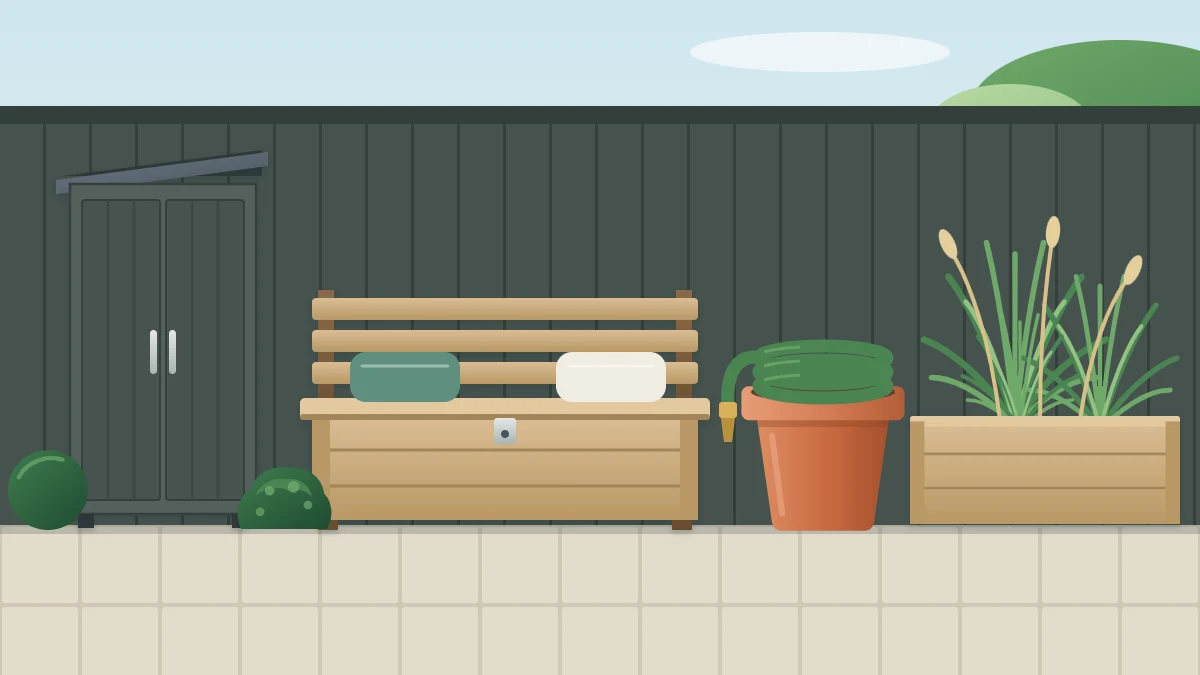
Tools, bins, a hose, cushions and half-empty bags of mulch take up the same floor area in a small yard as they would in a large one. The difference is that a small yard has nowhere for them to hide, so they end up in the view from every window.
The small garden storage ideas below are sorted by where they go, because position matters more than the product. Good storage in a small space is the kind you stop noticing: it sits in the dimmest spot, borrows the color of the fence and does one clear job.
Start with a list, not a shed
Before you buy anything, gather everything you keep outside and sort it into three groups: used every week, used a few times a year, and not used at all. The third group is usually bigger than expected.
Letting that group go is the cheapest storage idea there is. What remains tells you how much room you really need, and it is often a bench and a cupboard rather than a building. Then measure the bulky things, such as the longest tool handle, the bins and the folded cushions, so that anything you buy is chosen to fit them.
Put storage where the eye goes least
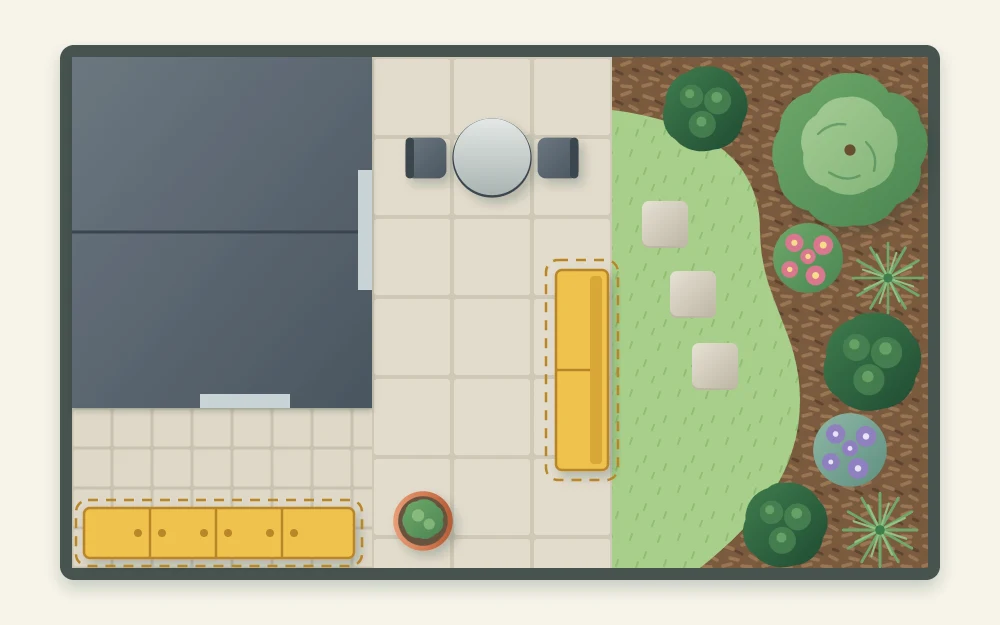
Stand at the back door, then sit in your usual seat, and note which parts of the garden you actually look at. Storage belongs in what is left: behind the line of the door, along the side of the house, or in the corner the sun never reaches.
This works for two reasons. Shady, awkward spots are the hardest places to grow plants or to sit, so you lose little by giving them to storage. It also frees the sunny, visible areas for sitting and planting. If you have a passage beside the house, a narrow side yard can double as a storage strip while still leaving a clear route to walk through.
Storage that doubles as something else
A storage bench
A bench with a lifting lid gives you a seat and a box in the footprint of one piece of furniture. It suits cushions, hand tools and toys. Place it against a boundary or at the patio edge, where a bench would go anyway, and leave room for the lid to open fully.
Under-bench and under-deck boxes
Low lidded boxes that slide under a fixed bench, or into the gap beneath a raised deck that already has an access hatch, use space that is otherwise dead. Keep them for things that do not mind a little damp, such as empty pots, canes and watering cans.
A fold-down potting shelf
A potting shelf that folds flat when you are not using it gives you a work surface without a permanent table. These are sold as ready-made units. Have one installed following the manufacturer’s instructions, and if the wall or fence is shared or rented, get the owner’s agreement first.
Slim storage for a side passage
A slim, lean-to style cupboard bought for the purpose is often the most useful single piece of storage in a small garden. It stands against a wall, takes up a depth of about 2 ft (roughly 60 cm) as a starting point, and stores long-handled tools upright, which a bench cannot do.
Check the width that remains once its doors are open. You still need to walk past with a bin, so treat the open-door position, not the closed one, as the real footprint. Keep meters, vents, taps and drain covers clear, because someone will need to reach them.
If you already have a shed, the inside of its door is free space. A bought tool rack or a row of hooks there keeps hand tools visible and off the floor. Fit them following the manufacturer’s instructions.
Screen the bins instead of boxing them in
Bins are the hardest thing to store. They are large, used every week and have to roll out to the street. Rather than enclosing them completely, screen only the side you see. A freestanding slatted panel, or a trellis with a climber growing from a planter, hides them from the house and leaves the open side facing the route out.
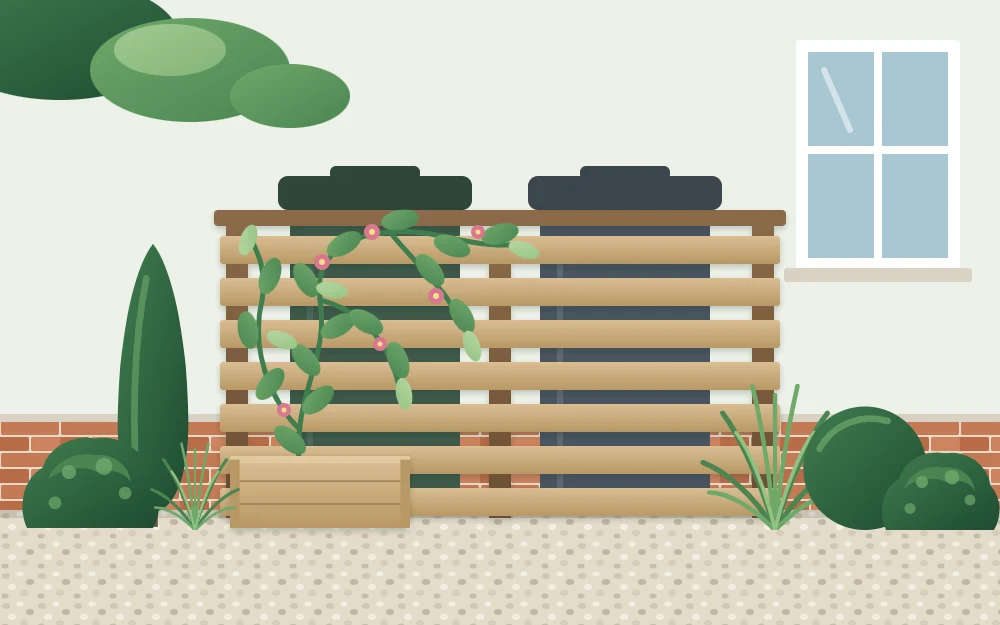
A planter or a few pots in front of the screen finish the job, because the eye stops at the planting and goes no further. An unused corner is often the right place for this, and it is one of several ways to put an awkward garden corner to work. If the screen stands on or near a boundary, confirm who owns that boundary and check local rules and any HOA covenants before you add to it.
The hose, the pots and other small things
A hose left in loops on the paving reads as mess from every angle. A hose reel, bought as a freestanding unit, or a wide hose pot beside the tap turns it into one tidy object.
Spare pots, canes and plant supports can go up rather than out. A ladder shelf or tiered stand that stands on the ground stores small pots neatly in the footprint of one, and the same thinking runs through most vertical ideas for small spaces. Put the largest items on the lowest level and check the stand after wind.
Three rules that make storage disappear
- Match the fence. Choose or paint storage in the same color as the boundary behind it. Without contrast there is no outline to catch the eye, so the unit recedes. Dark, matte colors recede the most.
- One job per unit. A cupboard for tools, a bench for cushions, a screen for bins. Mixed storage turns into a pile, and you have to empty it to find anything.
- Keep doors and lids clear. Leave the swing of every door and the lift of every lid free of pots and planting. Storage that is awkward to open stops being used, and things drift back onto the patio.
Tip
Soften storage rather than trying to hide it completely. One planter of tall grasses beside a cupboard breaks its outline, and that is usually enough to stop it drawing attention.
A quick guide to what goes where
| What you store | Idea | Best position |
|---|---|---|
| Cushions, hand tools | Storage bench | Patio edge or against a boundary |
| Long-handled tools | Slim cupboard | Side passage or shady wall |
| Bins | Open-sided screen with planting | Near the gate, out of the main view |
| Hose | Reel or hose pot | Beside the tap |
| Spare pots and canes | Ground-standing shelf or under-bench box | A dim corner |
Frequently asked questions
Where is the best place for storage in a small garden?
Choose the spot you look at least and that gets the least sun, such as a side passage, the area behind the back door or a dim corner. Plants and seats struggle there anyway, so you give up very little, and the brighter, more visible parts stay free for sitting and planting.
How do I hide garden bins without building anything?
Stand a freestanding slatted panel or a planter with a trellis and climber between the bins and the house, and leave the side facing the gate open. A few pots in front help further. Confirm who owns any boundary nearby and check local rules and HOA covenants before adding screens.
What color should garden storage be?
The same color as whatever stands behind it, usually the fence or wall. When a cupboard or bench matches its background there is no strong outline to notice, so it fades into the boundary. Dark, matte shades tend to recede more than pale or glossy finishes.


