Side Yard Garden Ideas for a Narrow Strip
Turn the passage between the house and the fence into a route that looks good and still works: a clear path, one slim planting strip, climbers and tidy storage.
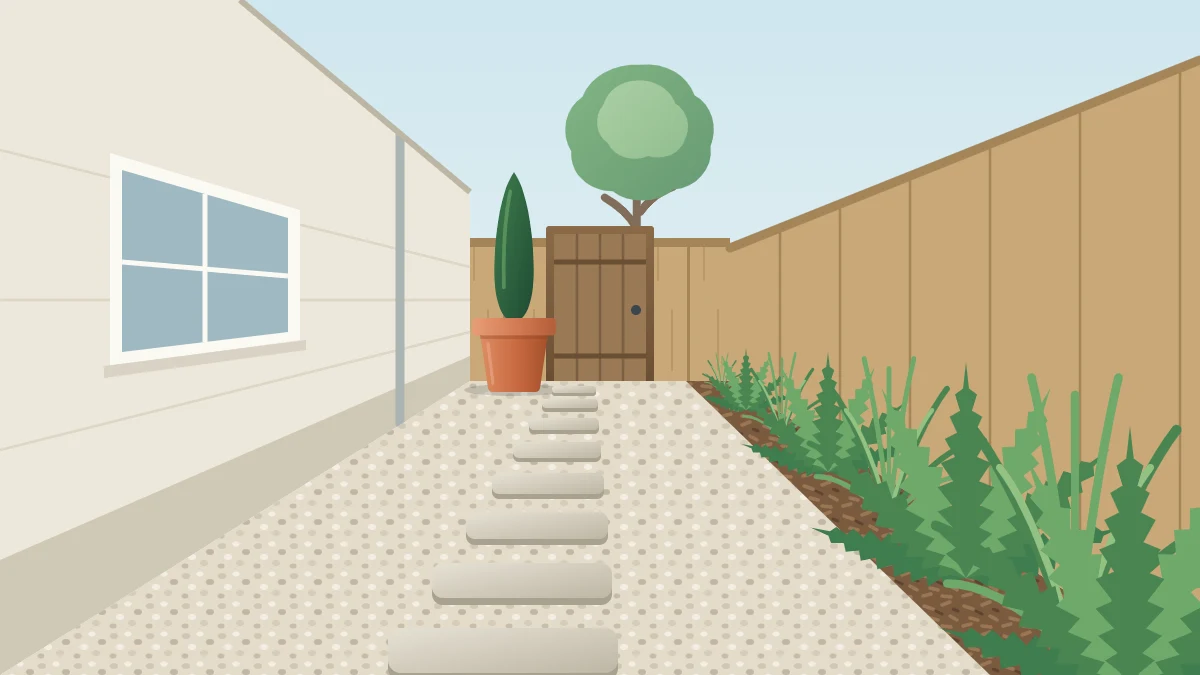
The strip between the house and the fence is usually the least loved part of a property. It holds the bins, a coil of hose and whatever has no other home, and you walk through it as quickly as you can.
It still has to work as a passage, and that is the starting point for the side yard garden ideas below. Each one keeps the route clear and the services reachable, then adds planting and order in the space that is left. A side yard treated this way becomes a pleasant walk and often the best storage spot you have.
Start with what has to stay clear
A side yard is a working space before it is a garden. Walk its length and note everything that needs access:
- Gates, and the direction each one swings.
- Utility meters, shut-off valves and outdoor taps.
- Vents, air-conditioning units and dryer outlets, which need open air around them.
- Drains, downspouts and the way water runs off after rain.
- The route the bins take to the street.
Then set a walking width and protect it. As a rough starting point, about 3 ft (roughly 90 cm) lets one person walk through comfortably with a bin or a wheelbarrow. Test it with the things you really move along the passage, and adjust. Everything else in the plan fits into what remains.

Lay stepping stones through gravel or groundcover
A solid strip of concrete makes a side yard look like a service alley. Stepping stones set in gravel, or in a low groundcover that tolerates light foot traffic, give the same dry footing and let the surface between them read as garden.
Space the stones to match a natural stride, and walk the spacing before you set anything. Use larger stones than you think you need, since small ones look fussy in a long strip. If the work involves digging out a base, call 811, the call-before-you-dig service, first to have buried utilities marked, because service lines often run down the side of a house.
For help choosing between gravel, pavers and other surfaces, see the guide to path shapes, widths and materials.
Plant one side only
In a strip this thin, beds along both edges squeeze the path and make the passage feel tighter. A single line of narrow planting along one side leaves the route generous and still greens the whole length.
Choose the side with more light, which is usually the fence side, since the house wall casts shade for part of the day. Pick plants with an upright or naturally slim habit, and check the mature spread on the label so they do not lean into the path in a few years. Repeat two or three kinds along the strip for a steady rhythm as you walk.
A sunny side yard near the kitchen door can also be a practical place for a line of herbs. The article on where to fit a small herb area covers the layout.
Use foliage for a dim strip
Many side yards get little direct sun, with a two-story wall on one side and a fence on the other. Flowers will be sparse there, so build the planting from leaves. Contrast feathery shapes with broad ones, and mix darker greens with paler or variegated ones that show up in low light.
Ferns, hostas and shade-tolerant sedges are widely grown examples of those shapes. Check that anything you choose suits your hardiness zone and the amount of moisture the strip really gets, because the ground beside a house can be very dry under the eaves or wet near a downspout.
Grow climbers on slim trellis panels
A fence the full length of a passage is a large blank surface at eye level. Climbers cover it using only a few inches of ground, where a shrub border would take half the path.
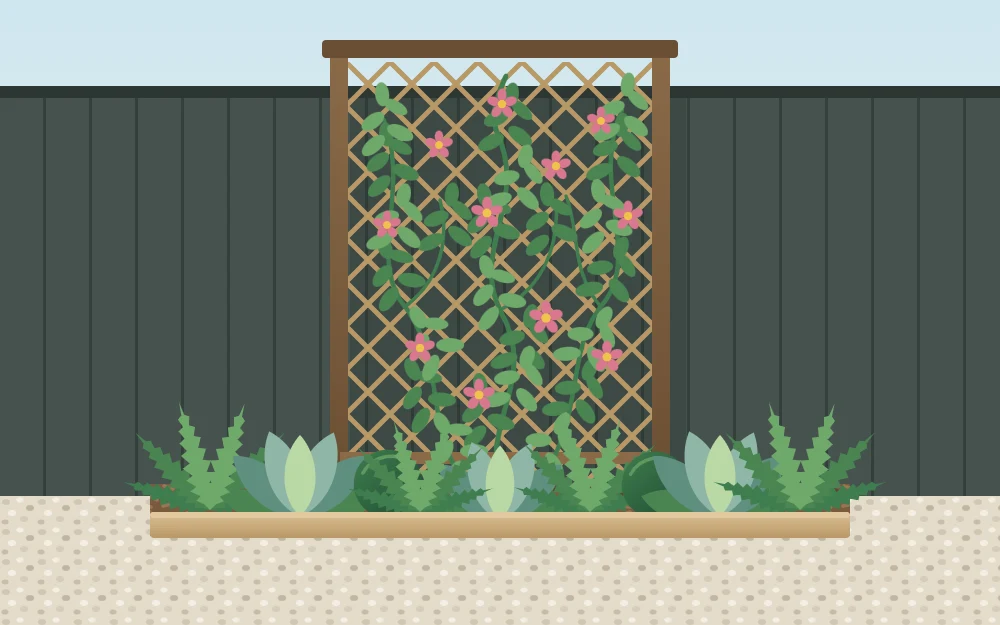
Freestanding trellis panels on their own posts, set just in front of the fence, are the simplest choice and leave the fence itself untouched. If you want a trellis attached to the fence, install it following the manufacturer’s instructions, confirm who owns the boundary, and get the owner’s agreement if it is shared or rented. Space a few panels evenly along the fence so the passage does not feel walled in.
Choose a climber with modest vigor and check local lists before buying, so you do not plant a vine that is invasive in your area. See the National Invasive Species Information Center for more detail.
Give bins and tools a slim storage zone
The side yard is often the right place for storage, close to the street and out of the main view. Gather it into one zone, ideally near the gate, so the bins have the shortest trip.
A freestanding slatted screen in front of the bins hides them from the garden end, and a slim cupboard made for outdoor use can hold tools beside them. Keep the same finish as the fence so the zone recedes. Further options are in these storage ideas that stay out of sight.
Put a destination at the end
A passage that ends in a blank fence feels like a dead end. Give the far end something to walk toward: a large pot, a painted gate, or a small tree just beyond the passage that shows above the fence line. The eye goes to it, and the strip becomes a view instead of a gap between buildings.
Keep it simple: one bold object reads clearly at a distance. A long side yard has much in common with a long back garden, so the techniques in these ideas for a long, thin garden are worth borrowing.
Tip
A few solar lights low along the planted side make the route usable after dark and show off the foliage. Choose ones made for outdoor use.
Check the house wall before you plant
Planting right against a house needs more care than planting against a fence. Before you commit to a bed on the house side, check a few things.
- Airflow. Leave open space around vents, outlets and equipment, and avoid dense planting pressed against siding, which holds moisture.
- Access. You will need to reach windows, meters and the wall itself for upkeep. Leave a gap you can step into.
- Water. Keep soil and mulch from piling against the wall, and do not block the path water takes away from the house.
Good to know
If you are unsure whether a bed beside the house could affect drainage or the wall, ask a local contractor or your extension office before planting. In a rented home, check with the owner first.
Frequently asked questions
How wide does a side yard need to be for planting?
There is no fixed figure. Set aside a comfortable walking width first, roughly 3 ft as a starting point, and test it with your bins or wheelbarrow. Any ground left over can hold a slim planting strip. If almost nothing is left, grow a climber on a trellis panel instead of making a bed.
What grows in a shady side yard?
Foliage plants usually do better than flowering ones in a passage shaded by a house wall and a fence. Ferns, hostas and shade-tolerant sedges are widely grown examples. Check each plant against your hardiness zone and against how dry or damp the strip is before you buy.
How do I hide trash bins in a side yard?
Group the bins in one spot near the gate and stand a freestanding slatted or trellis screen in front of them on the garden side. Match the screen to the fence color so it recedes, and leave enough room to wheel each bin out without moving anything else.


