How to Divide a Small Garden Into Zones
A step-by-step method for fitting seating, growing space and storage into one small plot: rank the uses, match them to light, size each zone and mark it without walls.
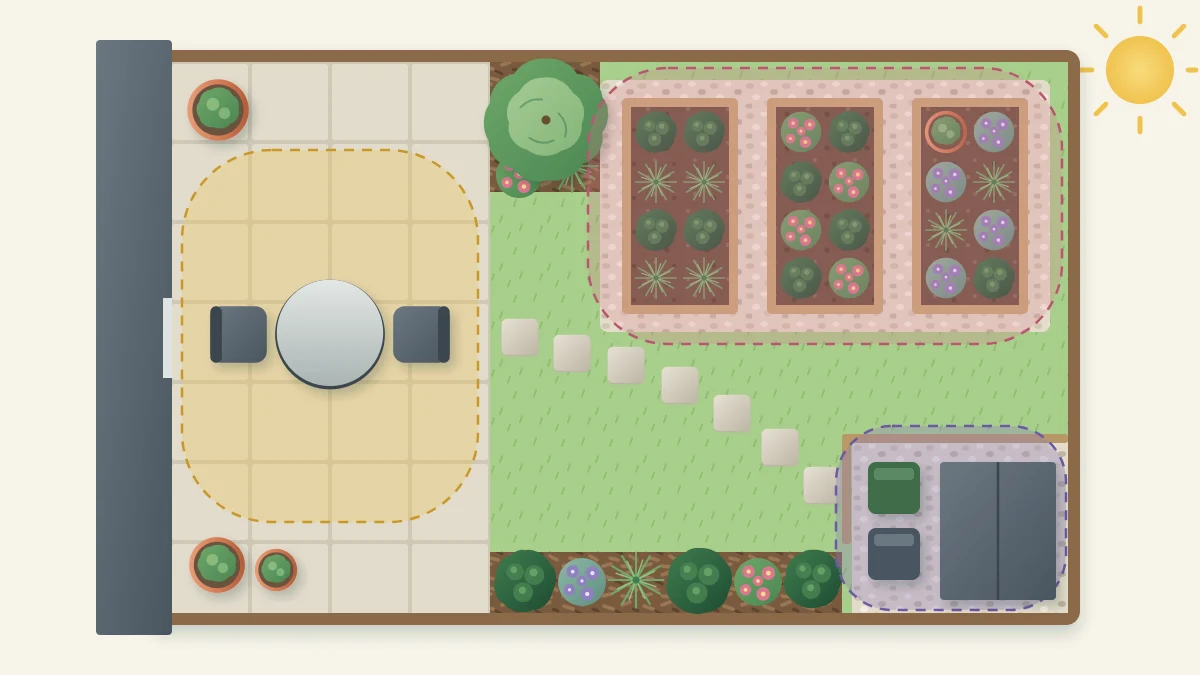
Project at a glance
What you need
- Scale plan of the garden
- Copies or tracing paper
- Pencil and eraser
- Colored pencils
- Tape measure
- String or a hose for marking shapes
A seat, somewhere to grow things and a place for the bins: most people want all three, and in a small plot it can be hard to see how they fit. The usual result is furniture, pots and storage spread evenly across the ground, with no part of it working well.
The answer is to divide a small garden into zones, giving each use its own area in the position that suits it best. It is done on paper first, it needs no walls, and it often shows that the garden holds more than you expected.
What you need before you begin
You need a scale plan of the garden with the sunny and shaded areas marked, plus a few copies or sheets of tracing paper to sketch on. You also need the rough sizes of the furniture and storage you own or intend to buy. Without real sizes, zones drawn on paper tend to be smaller than what has to go in them.
The steps in order
- List what the garden must do. Write every use down: eating outside, a reading chair, herbs, flowers, play, bins, tools, a bicycle.
- Rank the list. Number the uses by importance. The top two get the best positions; the others fit around them.
- Match each use to conditions. Place seating where the sun falls at the time you sit out, growing where the light is best, and storage in the dimmest, least-seen spot.
- Size each zone. Work out the area each one needs from the furniture and the room to move around it.
- Draw bubbles. Sketch a loose blob for each zone on a copy of the plan, in its position and at its rough size.
- Add the route. Draw one line from the door through or past every zone.
- Firm the bubbles into shapes. Turn the blobs into clean shapes that fit together, and choose how each zone will be marked on the ground.
Matching uses to light and views
Position matters more than size. A small seat in the right place is used daily, and a large one in the wrong place is not used at all.
- Seating goes where the sun is when you are outdoors. If that is morning coffee, find the morning sun; if it is the evening after work, find the last sunny patch, even when it is at the far end from the house.
- Growing gets the best light, because most flowering plants, herbs and vegetables need several hours of direct sun. Plants cannot make do with shade the way a storage box can.
- Storage takes the dimmest ground that is still easy to reach, ideally where it cannot be seen from the main window or the seat. Good ground is too scarce to spend on bins.
How big each zone needs to be
Measure the furniture, then add room to move. As a rough starting point, allow about 3 ft (roughly 90 cm) behind each dining chair so it can be pulled out and someone can pass. A small table for two therefore needs a floor roughly 8 ft (about 2.4 m) across.
A single lounge chair needs its own length and width plus space to step in from one side. A storage zone needs the footprint of the unit plus room to open its doors or lid fully. A growing zone is the most flexible: a bed can be almost any shape, as long as you can reach its middle without stepping on the soil.
If the zones do not fit, shrink the lowest-ranked one first, or let it share. If the seating zone is a paved area by the house, the guide to tiny patio garden ideas shows how to keep it green without losing the room to sit.
From bubbles to shapes
Bubbles are deliberately vague. They let you test where things go and how they connect before you worry about edges.
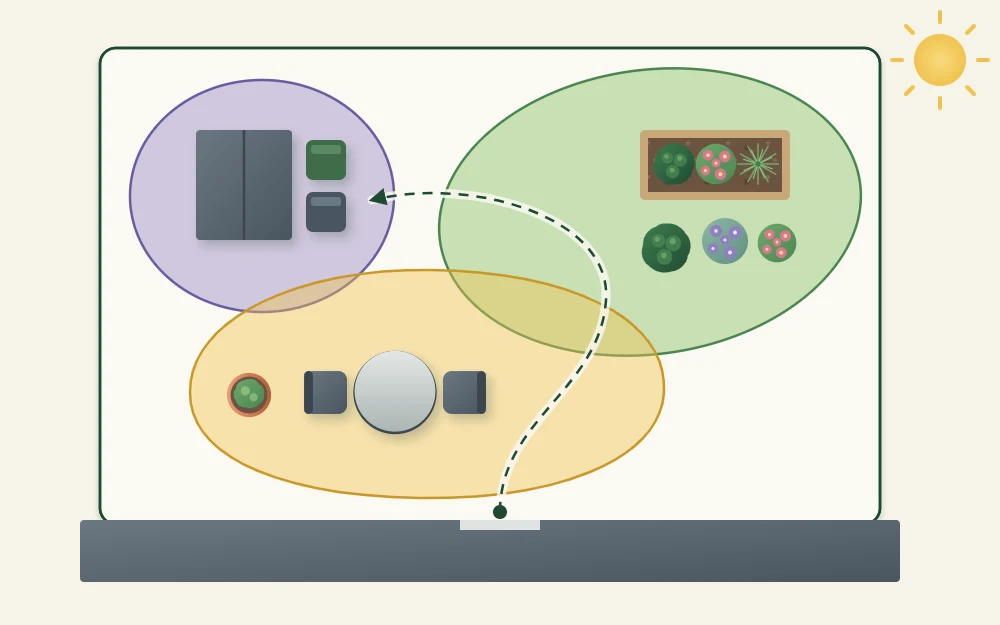
When one arrangement works, firm it up. Straighten the blobs into rectangles, circles or angled shapes that share edges, so no slivers of ground are left between them. Picking one of the patterns in the guide to small garden layout ideas at this stage gives the zones a common geometry, which is what stops them looking like separate patches.
Ways to separate zones without walls
Solid dividers take up room and block light, and a small garden cut into closed boxes feels smaller. A zone only needs a signal that one area has ended and another has begun.
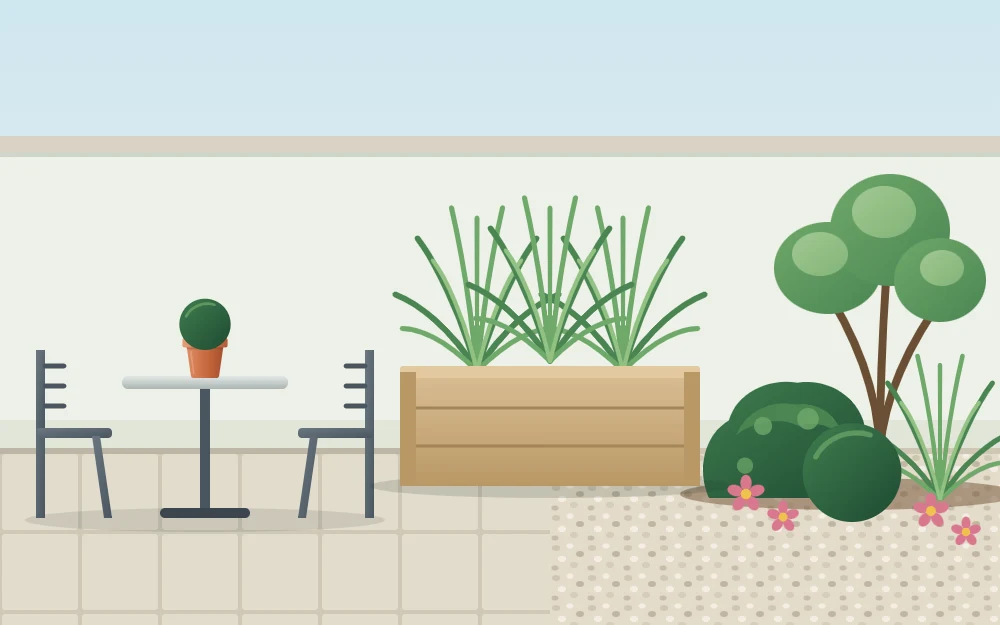
- A change of surface: paving to gravel, or gravel to lawn. It takes no space at all and is the clearest signal underfoot.
- A low planter: a planter box at about knee to seat height marks an edge while keeping the view open above it.
- An open screen: slats or a freestanding trellis that you can partly see through. It shelters a seat without shutting it in; the guide to small garden privacy ideas covers where a screen does most good.
- A step: even one change of level makes the next area feel like a different place.
- A tall pot: a single large pot at a corner works like a gatepost, marking a threshold with one object.
Good to know
Freestanding screens and tall pots can shift in strong weather, so check them after wind. Before adding any screen close to a boundary, check local rules and any HOA covenants.
Keep circulation to one clear route
Paths use ground that nothing else can use, so a small garden can afford only one main route. Run it from the door past each zone, along the edge of the seating area and not through the middle of it, where people would have to squeeze behind chairs.
The route does not have to be a built path. It can be a strip of the patio kept clear, or a few stepping stones. The guide to small garden pathways covers rough widths and surfaces.
Let zones overlap and share
Zones are not rooms with one purpose each. The planter that edges the seating area can be the herb bed. A storage bench is both seat and cupboard. The open gravel that serves as the route can be play space in the afternoon.
Shared ground is how a small garden holds three or four uses. Aim for two zones that are properly sized and well placed, and let the others borrow from them.
Frequently asked questions
How many zones can a small garden have?
Two well-sized zones usually work better than four cramped ones. Most small gardens manage a seating zone and a growing zone comfortably, with storage tucked into a dim corner. Further uses are best handled by sharing, such as a storage bench or herbs in the planter that edges the seating.
Where should the seating area go in a small garden?
Put it where the sun falls at the time of day you sit outside, even if that is not next to the house. Check the view from the seat and how overlooked it feels as well. A seat that is sunny and sheltered gets used; one placed only for convenience often does not.
How do I separate zones without making the garden feel smaller?
Use signals instead of barriers. A change of surface, a low planter box, a single step or an open screen you can partly see through all mark where one area ends. They keep light and views moving across the whole garden, which solid dividers would block.


