Small Herb Garden Ideas: Where to Fit a Herb Area
Seven places a herb area fits in a small yard, from the kitchen door to a checkerboard bed, and the layout rules that keep herbs sunny, within reach and good to look at.
Herbs ask for very little room. A handful of plants covers most of what a household cooks with, so the real question is not how to find space but which space to give them.
These small herb garden ideas are about placement and layout: where a herb area fits in a small yard, how to arrange it so it gets used, and how to make it look like part of the design rather than an afterthought. For growing detail, see Clemson Cooperative Extension’s guide to herbs.
Two things decide the spot: sun and reach
Most culinary herbs want plenty of sun, so begin with the brightest places you have. A spot that gets sun for most of the day suits the widest range. Leafy herbs such as parsley, chives and mint cope with less.
The second test is reach. Herbs are picked a few leaves at a time, often in the middle of cooking. A herb bed at the far end of the garden gets forgotten, while one you pass every day gets used and trimmed, which also keeps the plants compact. So where you have a choice between two sunny spots, pick the one nearer the kitchen or on the route you already walk.
Seven places a herb area fits
By the kitchen door
This is the most convenient position, as long as it has the light. A group of pots or one planter beside the step is enough. Keep the door swing and the route clear so the pots do not turn into an obstacle.
Along a path
A narrow strip beside a path makes every plant reachable from the paving, with no need to step on the soil. Low, mounding herbs such as thyme at the front and upright ones behind soften the hard edge, and you brush past the scent as you walk.
In a sunny corner
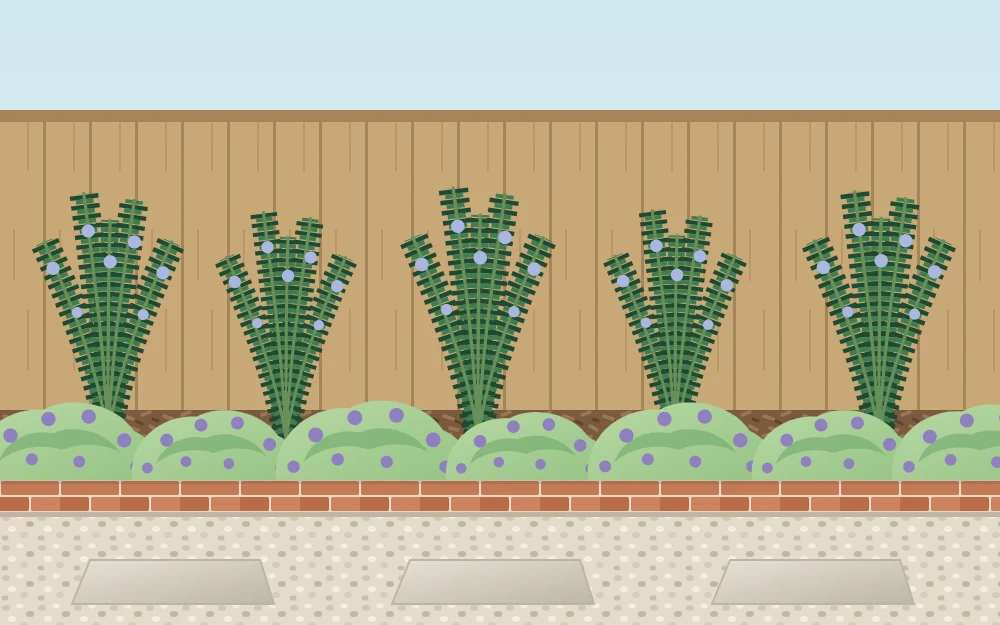
Corners that trap warmth between two walls or fences suit the woody, sun-loving herbs. A corner also gives a herb area a natural boundary, so it reads as its own small zone.
In one raised bed divided into squares
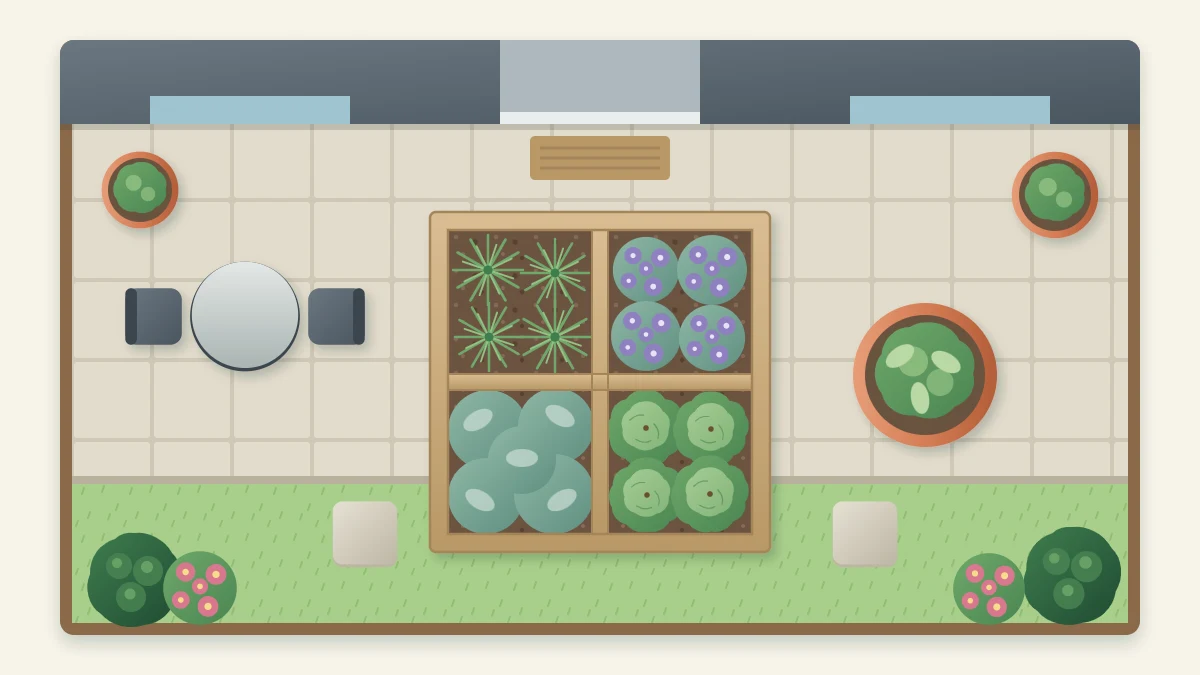
A single bought raised bed, split into four or more sections with canes or thin strips of wood laid on the soil, gives each herb its own square. The divisions stop stronger plants from swamping weaker ones and make the bed look ordered even when the plants are small. Keep it narrow enough that you can reach the middle from the edge, about 3 to 4 ft (roughly 90 to 120 cm) across as a starting point.
On a tiered stand
Where there is no ground to spare, a tiered plant stand that stands on the paving stacks several pots in the footprint of one. Put the largest pots on the lowest step and check the stand after wind. More ways to use height are in the guide to vertical garden ideas for small spaces.
As an edging to a flower bed
Herbs do not need a bed of their own. Chives, thyme and parsley make a neat, low front row to an existing border, and repeating one herb along the whole edge ties the bed together.
In a checkerboard or wheel pattern
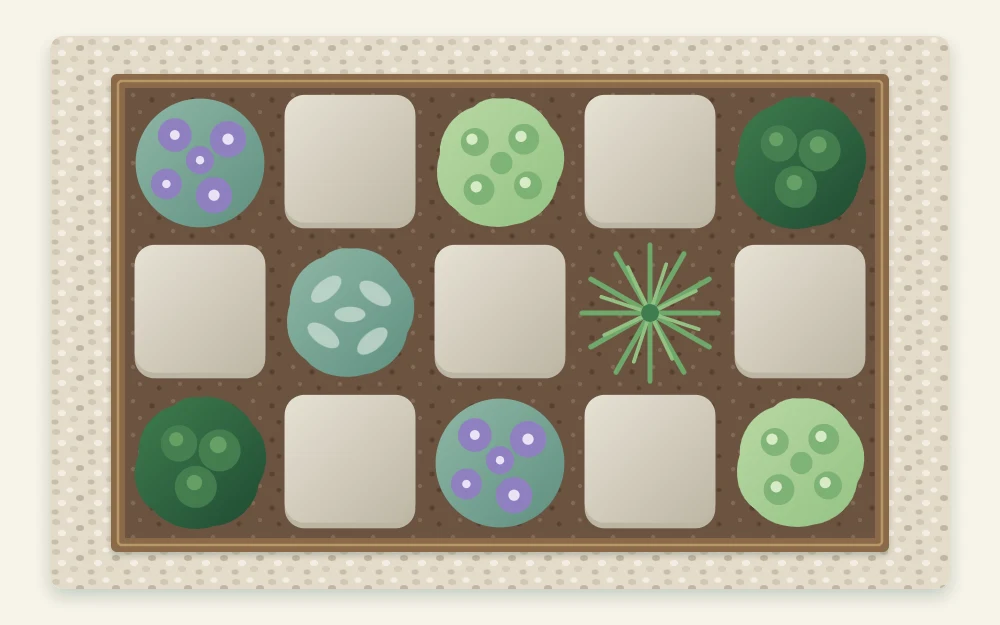
Alternating paving squares with planted squares makes a small herb bed that is also a feature. The stones give you somewhere to stand, warm the plants around them and keep each herb in its own space. A wheel does the same job with spokes of brick or stone radiating from a central pot.
Good to know
If your layout means digging a new bed or lifting ground for paving, call 811 first to have buried utilities marked.
Group herbs by what they need
Herbs fall into two broad groups, and keeping them apart makes the layout easier to live with.
- Woody, sun-loving herbs such as rosemary, thyme, sage, oregano and lavender like the hottest, best-drained position. Put them together in the sunniest part of the bed, the top of a stand or the corner by a warm wall.
- Leafy herbs such as parsley, chives and cilantro prefer soil that stays moister and tolerate a little shade. Give them the lower, cooler side.
The reason is practical. Plants that share a bed share its conditions, so mixing the two groups means one of them is always unhappy. Rosemary and some other herbs are not hardy everywhere, so check that each one suits your hardiness zone before you plan around it.
Give mint its own pot
Mint spreads by underground runners and will work its way through a small bed and crowd out its neighbors. A pot of its own, standing on paving rather than on soil, keeps it where you put it. A single handsome pot of mint beside the door or at the corner of the bed also works as a small accent.
Make the herb area part of the design
Herbs are good-looking plants, and treating them that way helps a small garden hang together.
- Use their shapes. Upright rosemary gives height, sage gives broad gray-green leaves, thyme makes a low mat and chives add fine vertical lines.
- Use their color. Purple sage, bronze fennel and golden oregano bring foliage color that lasts longer than flowers.
- Repeat a container. Herbs in matching pots or one long planter look intentional. These planter box ideas for small patios show how a planter of herbs can also edge a seating area.
- Keep it to one place. A single clear herb area looks better, and is easier to pick from, than pots dotted around the garden.
Tip
Choose herbs from what you already cook. Five kinds you use every week earn their space far better than fifteen you rarely touch.
How much room to allow
A workable herb area can be as small as a bed about 3 ft (roughly 90 cm) square, a strip the length of a short path or a group of five pots. Check the mature spread on each label, because a young rosemary or sage gives little hint of the space it will want later.
When to set it up
Spring is the natural time to lay out a herb area, once the risk of frost has passed in your area and young plants are widely on sale. It fits well into a wider tidy-up, and the spring refresh plan for a small garden sets out the order to work in.
Frequently asked questions
Where is the best place for a small herb garden?
Pick the sunniest spot that is also close to the kitchen or on a route you walk every day. Sun suits the widest range of culinary herbs, and being within easy reach means you actually pick them. A bed by the back door or a strip beside a path meets both needs.
Can herbs be mixed into a flower bed?
Yes. Many herbs are attractive plants in their own right. Chives, thyme and parsley make a tidy front edge, while sage and rosemary add foliage and shape among flowers. Place each one where the bed's sun and soil conditions match what that herb prefers, and keep them reachable from the edge.
Why should mint be kept in a separate pot?
Mint spreads through the soil by runners and can quickly take over a small bed, pushing out slower herbs around it. Keeping it in its own pot, set on paving instead of bare soil, limits where it can travel and lets you place it near the door for picking.


