Narrow Garden Ideas: How to Design a Long, Thin Space
A long, thin garden does not have to feel like a corridor. Learn how to break up the length, move the eye from side to side and give the far end a purpose.
A long, thin garden has one habit that spoils it: you open the door and see straight to the far fence. With nothing to stop the eye, the two long boundaries seem to squeeze inward and the whole plot reads as a corridor you walk down and back again.
The narrow garden ideas below all work on that one problem. Each of them either interrupts the long view, pulls your attention from side to side, or gives you a reason to stop along the way. You do not need all of them. Two or three, used together, are usually enough to change how the space feels.
Why a narrow garden feels like a corridor
Three things tend to create the corridor effect. The first is a straight path running the full length. The second is thin beds of equal width along both fences, which draw two more parallel lines. The third is an empty middle that shows you the whole plot in one glance.
Every line in that arrangement points the same way, so the eye rushes to the end. The fix is to slow the journey down.
Break the length into two or three sections
Dividing a long plot into shorter sections is the most effective change you can make. Each section becomes closer to a square, which is a much more comfortable shape to sit or stand in than a strip.
The dividers should reach only partway across. A bed that comes in from the left fence, then one further along that comes in from the right, leaves a gap to walk through and hides part of what lies beyond. Because you cannot see the whole garden at once, it feels as if there is more of it.
Good partial dividers include:
- A planted bed that juts out from one boundary, with something tall in it.
- A freestanding trellis screen with a climber, set at right angles to the fence.
- A long planter box with upright grasses.
- A change of surface, such as paving giving way to gravel or lawn.
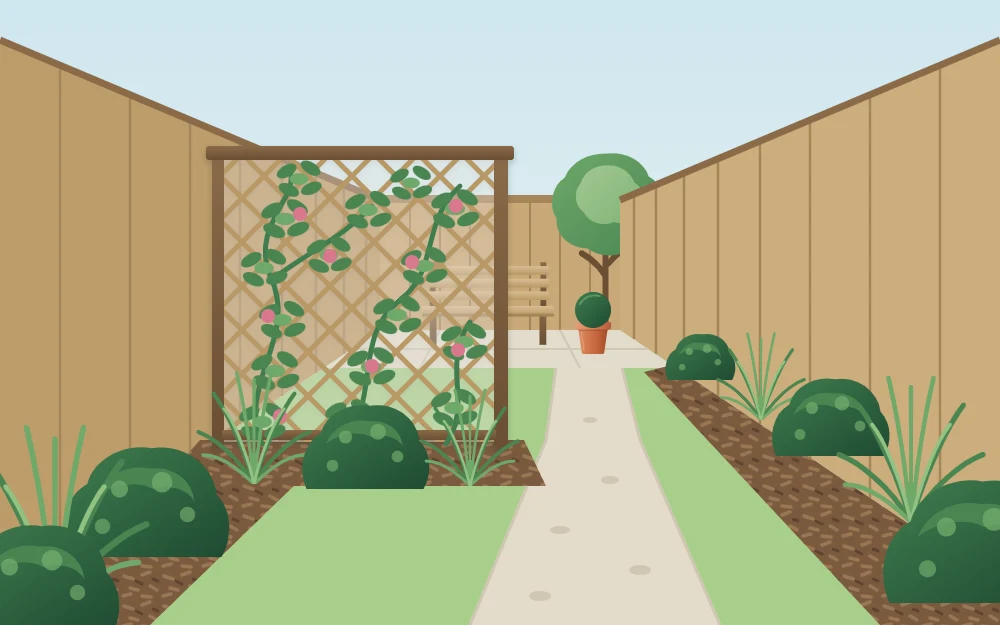
Keep the screens open, not solid, so light and air pass through. Before adding anything tall near a boundary, check local rules and any HOA covenants.
Turn the layout sideways or on the diagonal
Lines that run across a narrow plot make it look wider, for the same reason that lines running along it make it look longer. Lay paving in bands from fence to fence, or set rectangular areas so their long sides run across the garden instead of down it.
Two layout patterns suit long plots especially well. In an offset layout, rectangles of paving, lawn and planting are staggered, one pushed to the left and the next to the right, so you move in a gentle zigzag. In a diagonal layout, the shapes are turned at an angle to the fences, and the longest line in the garden becomes the diagonal, which is longer than either side.
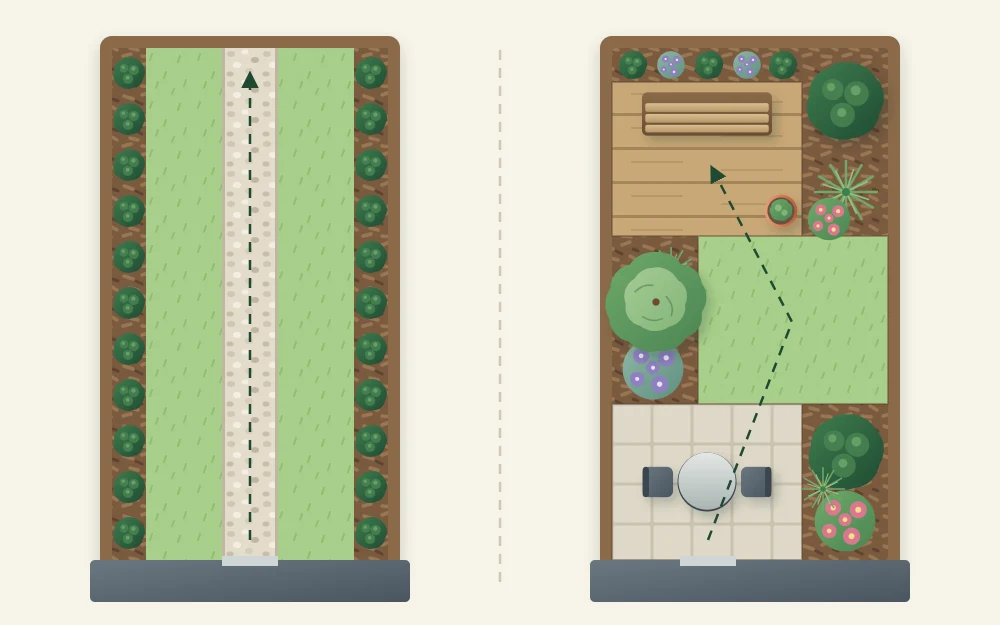
Try both on a copy of your plan first. A diagonal can leave awkward triangles in a very thin plot, where offset rectangles are often easier.
Keep the path off the center line
A path straight down the middle splits a narrow garden into two strips that are each too thin to use. A path tight against one fence is little better, because it underlines the longest boundary.
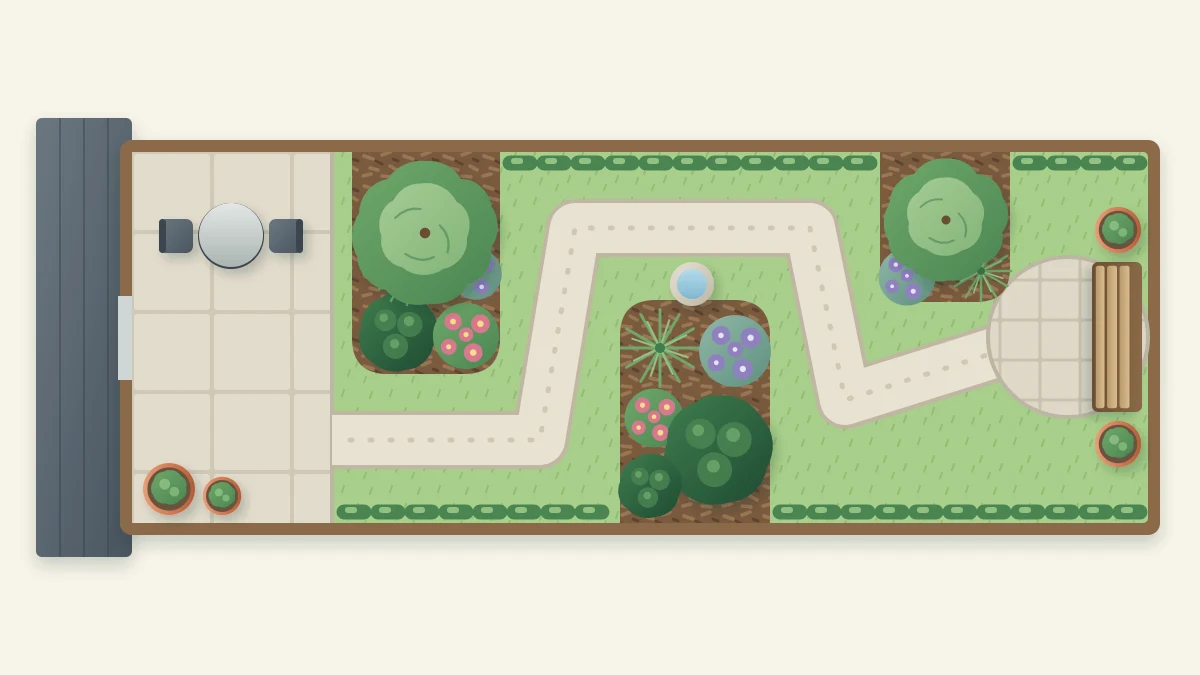
Let the route cross from one side to the other as it passes each divider instead. The crossing points are where the garden seems widest, and they give you a slightly different view every few steps. For shapes, widths and surfaces, see the guide to planning a path in a small garden.
Vary the width of the beds
Thin beds of the same depth along both fences are the default in narrow gardens, and they are too shallow to hold more than a single row of plants.
Take the same planting area and redistribute it. Make a bed deep where it juts into the garden, then let it shrink to almost nothing further along. The open space now swells and narrows, which reads as a series of places.
Tip
Where a bed narrows to nothing, cover the fence with a climber. You keep green on the boundary without giving up floor space.
Use the long boundaries for climbers
In a plot only a few strides wide, the two long fences are always in view. Climbers turn them into a green backdrop using very little ground.
Freestanding trellis panels on their own posts, set just in front of the fence, are the simplest route. If you prefer a trellis attached to the fence itself, install it following the manufacturer’s instructions, confirm who owns the boundary, and get the owner’s agreement if it is shared or rented. Whatever you plant, check that it suits your hardiness zone, read the mature height and spread on the label, and check local lists so you do not plant a vine that is invasive in your area.
Give the far end a destination, and add a surprise halfway
A bench, a large pot or a small tree at the far end turns the length into an approach and gives you somewhere to walk to. Place it slightly to one side so it appears gradually.
Then tuck something smaller into the middle section, out of sight of the house: a water bowl, a single chair, a pot of scented plants. A garden you have to explore feels larger. More techniques of this kind are in the guide on making a small garden look bigger.
Plan around the shade from tall boundaries
Narrow plots are often shaded for much of the day, because fences, walls and neighboring buildings sit close on both sides.
Watch where the light falls at breakfast, midday and early evening. Put the seat where the sun reaches at the time you most want to sit outside, even if that is the far end and not by the door. Give the brightest stretch to flowering plants, and use foliage plants that cope with shade along the darker fence.
Good to know
Every screen or tall plant you add casts shade of its own. Stand a cane or a tall box where you plan to put it and look at the shadow before you commit.
If your space is closer to a passage beside the house than a full garden, the ideas for a narrow side yard strip will fit it better.
Frequently asked questions
How do you make a long narrow garden look wider?
Use lines that run across the plot instead of along it. Lay paving in bands from fence to fence, stagger rectangles of lawn and planting from side to side, and let beds jut out partway across. Each of these pulls the eye sideways, so the long boundaries feel further apart than they are.
Should a path run straight down a narrow garden?
It is usually better if it does not. A straight central path divides the plot into two thin strips and speeds the eye to the far fence. A route that crosses from one side to the other between planted dividers slows the walk down and makes each section feel like its own place.
How many sections should a narrow garden have?
Two or three suit most long plots. Aim for sections that are roughly as long as the garden is wide, so each one is close to a square. More than three in a small plot tends to feel cluttered, and each space becomes too small to hold a seat or a useful bed.


