Tiny Patio Garden Ideas That Leave Room to Sit
Make a small paved patio green without giving up the table and chairs. These ideas put the seating first, then fit planting into the edges, corners and height.
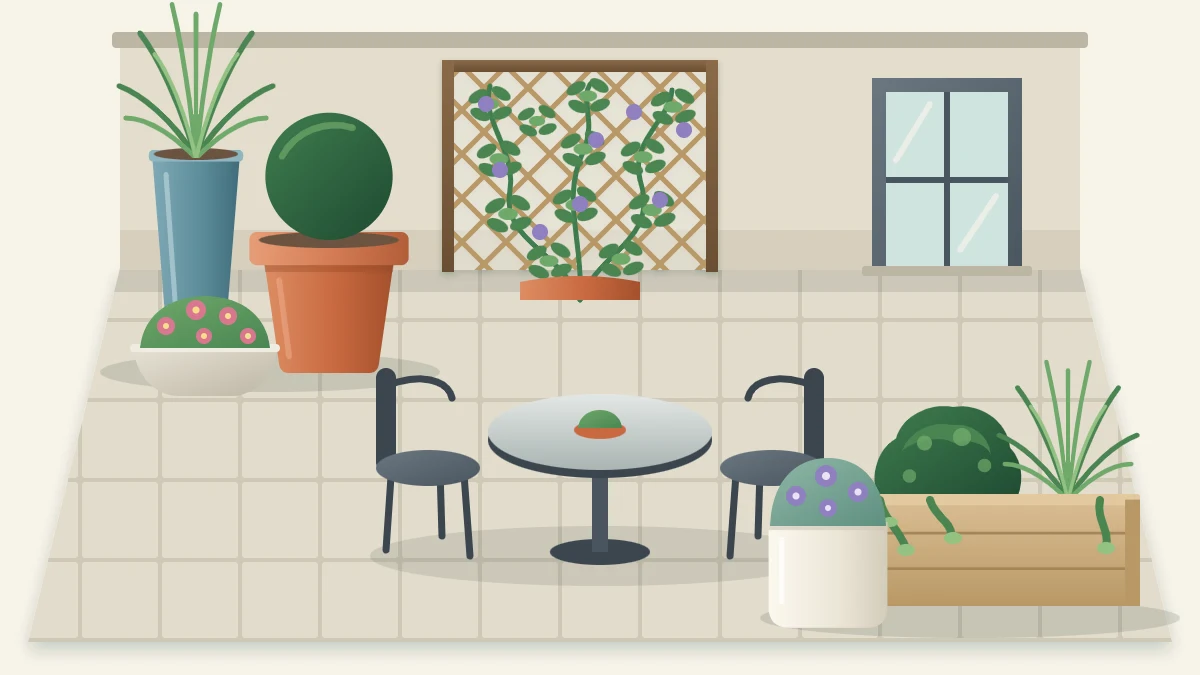
A small paved patio forces a choice that bigger spaces never face. Every pot you add takes floor from the chair, and every chair takes floor from the plants. Many patios end up losing both ways, with a ring of small pots and a table nobody can pull a seat out from.
These tiny patio garden ideas start from the other direction. Settle where you will sit first, then fit the green around that space, on the edges, in the corners and up the boundaries. The result is a patio that looks planted and still works as a room.
Start with the furniture footprint
Furniture needs more floor than it appears to. A chair has to slide back before you can sit in it, and you need room to walk behind someone who is already seated. Decide on the table and chairs you really use, then mark their footprint on the paving with chalk or string, including the space the chairs move into.
As a rough starting point, allow about 2 ft (roughly 60 cm) behind each chair for pulling it out. Treat that as a guide to test with your own furniture, not a rule. Whatever lies outside the chalk line is the space available for plants.
Two fixed things also need to stay clear: the swing of the door and the route from the door to wherever you go next, whether that is a gate, a tap or the rest of the yard. Mark those too.

Keep the center clear and green the edges
An open middle is what makes a tiny patio feel usable. When the floor in the center is uninterrupted, the eye reads the full width of the space. Scatter pots across it and the patio seems to shrink to the gaps between them.
Corners are the best places for planting because furniture rarely fits into them and nobody walks through them. Fill two corners generously and leave the others plain. Planting on every edge can make a small patio feel like the bottom of a well, while planting on two sides frames the seat and leaves the space open.
Use a few large planters, not many small pots
This is the idea that changes a patio most. Ten small pots create ten separate things to look at, and the space reads as busy. Three large planters take up a similar amount of floor, hold bigger plants, and read as part of the design.
Choose one material and one color for all of them so they recede and let the plants show. Then group them tightly instead of spacing them along a wall. The guide to arranging containers as a group explains how to vary the heights so a cluster looks composed.
Long, low planters do a second job. Set along the open side of the patio they make an edge, which gives a paved square the feeling of an enclosed room without a wall. There are more layouts of this kind in the article on planter boxes that shape a small patio.
Go up in one place
Height adds a lot of green for very little floor. One climber on a trellis, or one tall narrow planter with upright grasses, lifts the planting to eye level, where you notice it most when you are sitting down.
A single vertical feature gives the patio a backdrop; three different ones compete. A planter with a trellis panel rising from its back edge is a freestanding option that sits on the paving. If you choose a trellis attached to a wall or fence, install it following the manufacturer’s instructions, and get the owner’s agreement first if the boundary is shared or rented.
A tall element placed on the overlooked side can also give the seat some shelter from view. For more ways to do that without closing the patio in, see these ideas for screening a small garden.
Choose seating that saves floor
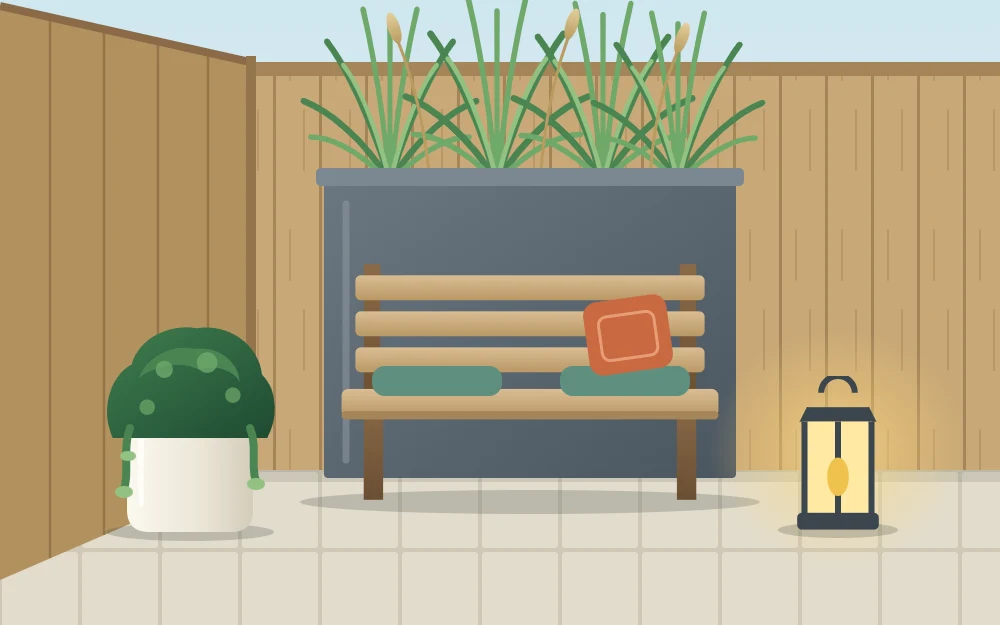
Loose chairs need space on all sides. A bench pushed against a boundary or into a corner needs it only in front, so it seats the same number of people in less room. Put a tall narrow planter behind or beside the bench and you sit with planting at your shoulder, which makes a paved corner feel like a garden.
Folding or stackable furniture earns its place too. A bistro table and two folding chairs can be leaned against the wall after a meal, which gives the floor back.
Tip
Before buying a bench or planter, lay out its size on the paving with cardboard or newspaper and live with it for a day or two. It is the quickest way to find out whether the door and the route stay clear.
Soften the hard edges
A small patio is mostly straight lines: paving joints, walls, the edge of a step. Plants that spill forward over the rim of a planter or onto the paving break those lines and make the hardscape look settled.
Low, mounding and trailing plants at the front of each planter do this well. Check that each one suits your hardiness zone and read the mature spread on the label, because a plant that spreads too far will creep into the space you cleared for chairs.
Keep to one surface material
Changes of surface divide a space, which is useful in a large yard and unhelpful on a tiny patio. One paving material, laid in one direction, makes the floor read as a single plane and so appear bigger.
Keep pots, furniture and cushions to a short palette of colors for the same reason.
Add one small focus
A patio feels finished when there is one thing for the eye to rest on. In a very small space this should be modest: a shallow water bowl among the planters, a single lantern beside the bench, or one pot larger than the rest. Place it where you see it from the seat and from the door.
A lantern or a few low lights also extend the hours the patio gets used. Choose solar lights or plug-in low-voltage kits made for outdoor use; anything wired into household mains is a job for a licensed electrician. The guide to lighting a small garden for evening covers where to put them.
Good to know
Tall planters and screens can shift in strong gusts on an exposed patio. Stand them where they are sheltered, and check them after wind.
Frequently asked questions
How many plants should I put on a tiny patio?
Think in planters, not plants. Two or three large planters grouped in corners usually look better and leave more usable floor than a dozen small pots. Add planting only up to the point where the chairs still pull out freely and the door and walking route stay completely clear.
Where should the table go on a very small patio?
Place it where the chairs can slide back without hitting a wall, a planter or the door swing, which is often slightly off-center. Mark the table and the pulled-out chairs on the paving with chalk first. If nothing fits comfortably, a bench against one boundary frees more floor than loose chairs.
How can I make a paved patio feel like a garden?
Bring planting up to eye level beside the seat and let it spill over hard edges. One climber or a tall narrow planter behind a bench, plus low trailing plants at the front of each planter, softens the straight lines of paving and walls so the space feels planted, not paved.


