Container Arrangement Ideas: Grouping Pots in a Small Garden
Turn a scatter of mismatched pots into arrangements that look designed: odd-numbered groups, limited materials, one large statement pot, repeated pots along steps and pairs that frame an entrance.
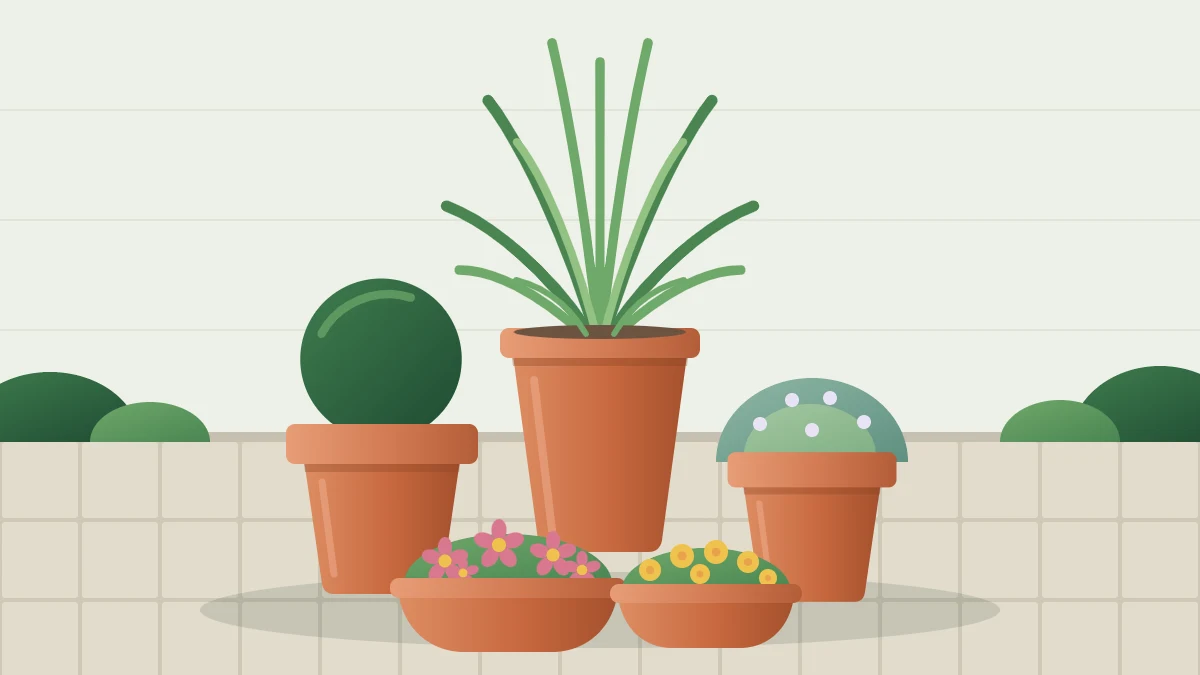
A scatter of mismatched pots is one of the most common sights in a small yard. Each one was a good idea on the day it came home, but together they read as clutter: many small things, none of them doing a job. The fix is rarely to buy more. It is to treat the pots you already own as part of the layout.
These container arrangement ideas are about placement and composition, not about growing. They cover where pots belong, how many should sit together, and why some groups look designed while others look as if they were put down and forgotten.
Gather everything before you arrange anything
Carry every pot to one open spot on the paving and sort them by material and color. Most gardens turn out to hold two or three families: a few terracotta pots, some glazed ones, a handful of plastic ones.
This matters because you cannot compose a group from pieces you see one at a time. Laid out together, the pots show you which family is big enough to build an arrangement from, and which odd ones are creating the cluttered look. The odd ones can go to a less visible spot, such as a utility corner or behind taller planting.
Limit the materials, vary the heights
The eye reads sameness as intention. When every pot in a group shares a material and a color, the group looks like one object, and the plants become the interest. Mix four finishes and the pots compete with the planting and with each other.
Height is where the variety should come from. A group with a tall pot, a medium one and a low, wide one has a clear outline, while three pots of the same height look like a line in a shop. If your pots are too similar, raise one:
- Stand it on a pot stand made for outdoor use.
- Set it on an upturned empty pot of the same material.
- Place it on a step, a low wall top or a paving block.
Check any raised pot after wind, and keep raised pots away from the places where people brush past.
Group in odd numbers
Three or five pots form a triangle when seen from above, with one clear high point. Even numbers tend to split into pairs, and the eye then reads two small groups instead of one confident one.
Set the pots close, touching or nearly so. A gap wider than a hand turns a group back into separate objects. For the exact placing of each pot, the step-by-step guide to building a three-pot arrangement walks through it one pot at a time.
Choose one large pot over five small ones
Small pots sit below eye level and disappear from across the garden. From the house they register as dots, and a small space full of dots looks busier and therefore smaller. One large pot holds its own at a distance and gives the garden a sense of scale.
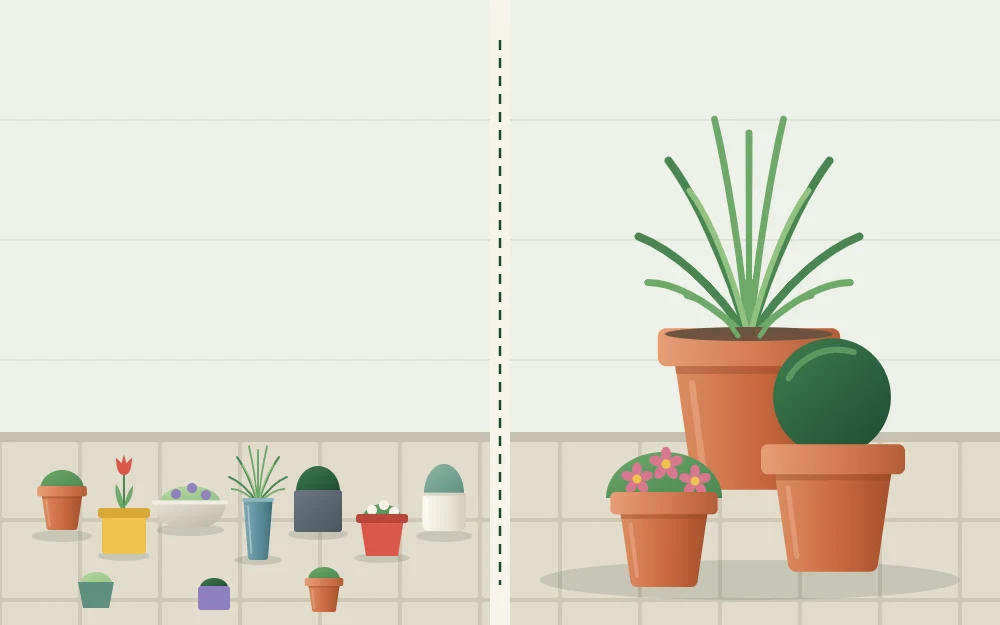
A statement pot needs room. Leave clear paving around it, roughly its own width on each side as a starting point, so its outline can be seen. Crowd it with smaller pots and it becomes the biggest item in a jumble. Used alone like this, a large pot can anchor a whole view, which is the subject of the guide to choosing a focal point for a small garden.
Repeat one pot for rhythm
A single pot repeated at even intervals does something a group cannot: it leads the eye along a line. Three or four identical pots with the same plant, set along a path edge or up the side of a flight of steps, make the route look deliberate and a little longer than it is.
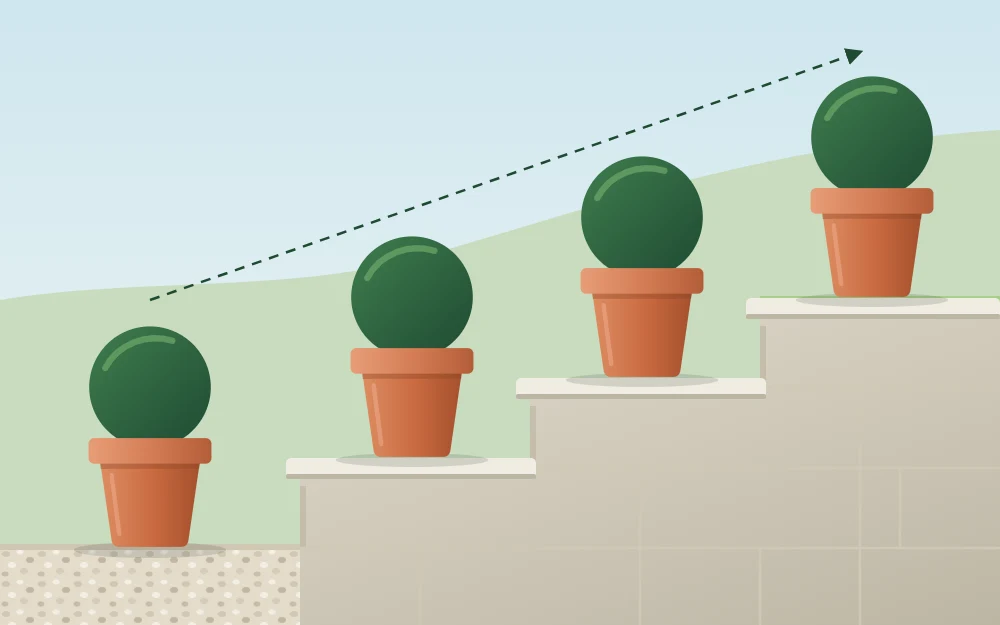
The repeat only works if it is exact. Use the same pot, the same plant and the same spacing. Clipped evergreen shapes suit this job because they look the same in every season; boxwood and dwarf conifers are common examples, but check that any plant suits your hardiness zone and read the mature height and spread on the label.
Good to know
Pots on steps belong at the side, never on the part of the tread where feet land. If the steps are narrow, put the repeated pots at ground level along the approach instead.
Use pots to mark edges and entrances
Pots can draw lines as well as fill corners. A row along the open side of a patio tells you where the sitting area stops without putting up a barrier. For a longer edge, a few planter boxes that edge or screen a patio will do the same job with fewer pieces.
A matched pair is the other classic move. Two identical pots either side of a door, a gate, a bench or the top of a path say “this is the way in” or “this is the place to sit”. Symmetry is formal, so use it once, at the most important threshold. Pairs at every opening cancel each other out.
Where arrangements work hardest
A group earns its place when it sits where the layout already needs something. Three kinds of spot nearly always qualify:
- Corners. A corner is dead space that the eye still travels to. A tall group there softens the right angle and uses ground that nothing else wants.
- The sides of steps and doors. Changes of level and thresholds are natural pauses, so a group here feels like part of the architecture.
- The end of a view. Stand at the back door or sit in your usual chair. Whatever lies at the far end of that sight line is where a single large pot or a tight group will be noticed most.
Avoid the middle of open paving. A group there has no backdrop, blocks the route and makes the floor area look smaller.
Tip
Judge every arrangement from where you usually see it, such as the kitchen window or the seat, not from where you were standing when you put the pots down.
Keep the group together over time
Arrangements drift. A new pot arrives, a plant fades, and within a season the scatter is back. A simple rule holds the design: when one pot comes in, one goes out, and anything new has to match the family already in the group.
Frequently asked questions
How many pots should be in one group?
Three or five is a reliable starting point. Odd numbers form a triangle with one high point, so the group reads as a single shape. Seven or more usually works only in a large corner, and at that size it helps to make one pot clearly bigger than the rest so the group still has a center.
Do all my pots have to match?
No, but each group should belong to one family. Pots that share a material and a color can differ in size and shape and still look planned. If you own several families, give each its own part of the garden instead of mixing them in one arrangement.
Where should I not put pots in a small garden?
Keep them off the walking part of steps, out of doorways and gateways, and away from the middle of open paving. Pots in those places interrupt the route and make the floor area look smaller. Corners, the sides of thresholds and the far end of a view are better positions.

