Small Garden Layout Ideas: 7 Plans That Make Space Work
Seven layout patterns for a small plot, from diagonals and circles to two garden rooms, with the plot shape each suits, what to watch and a comparison table.
A layout is the pattern the ground makes: where the open space sits, where the planting goes and which direction the lines run. In a small plot that pattern does most of the design work, because it decides where the eye travels and how much of the garden you can actually use.
The seven small garden layout ideas below are well-established patterns. Each one suits certain plot shapes and has something to watch, so treat them as options to test on paper, not as rules.
Begin with copies of your plan
These patterns only make sense against real dimensions. If you do not have a scale drawing yet, follow the guide on measuring a small garden and drawing a plan first, then make several copies.
Sketch each layout that appeals to you on its own copy. Seeing three versions side by side shows quickly which one gives a seating area of a usable size and which one leaves awkward scraps. It costs nothing to be wrong at this stage.
Layouts that change the direction of the lines
1. The diagonal layout
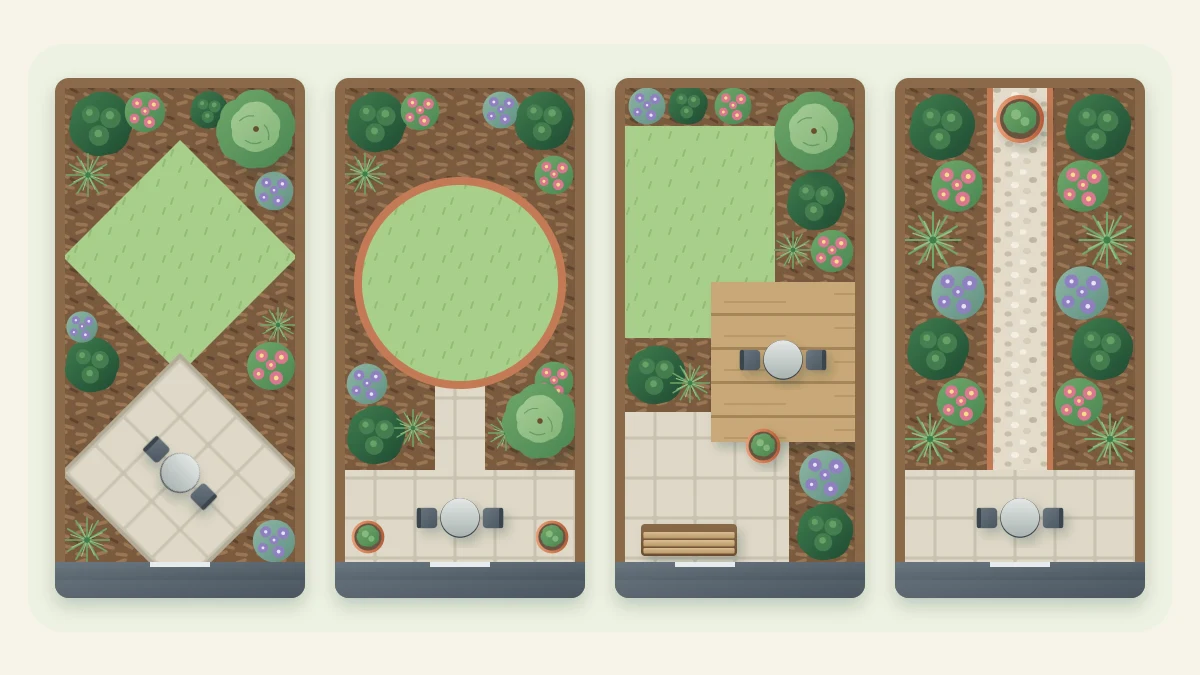
Paving and beds are set at 45 degrees to the house instead of parallel to it. The longest line in any rectangle runs from corner to corner, so turning the layout sends the eye along that line and away from the nearest fence.
It suits square and short, wide plots best. Watch the corners: the triangles left over should become deep planted beds, not slivers of paving, and angled paving means more cut pieces for whoever lays it.

2. The circle or oval
A round lawn, gravel area or paved circle sits in the center, with planting filling everything outside it. A curve has no corners for the eye to stop at, so attention moves around the shape instead of out to the boundary, and the corners of the plot disappear into foliage.
A circle suits a square plot; stretch it to an oval for a rectangle. Make the shape generous and keep its edge crisp. A circle that is too small reads as a dot in the middle of a box.
3. Offset rectangles
Two or three rectangles of paving, lawn and planting overlap, each shifted sideways from the last. Because no edge runs the full length of the garden, the eye steps from side to side and the plot seems wider.
This is the classic answer for a long, thin plot, and the guide to narrow garden ideas takes it further. Keep to three rectangles at most and vary their sizes, or the pattern turns fussy.
Layouts built around a route or an edge
4. A central path with beds either side
A straight path runs from the door, with planting on both sides. It is orderly and practical, because every plant is within reach, which makes it a good choice when growing is the main use.
It works in square or short plots. In a long one it stresses the length and can feel like a corridor, so end it with something worth walking to. The guide to small garden pathways covers shapes, widths and surfaces.
5. The courtyard layout
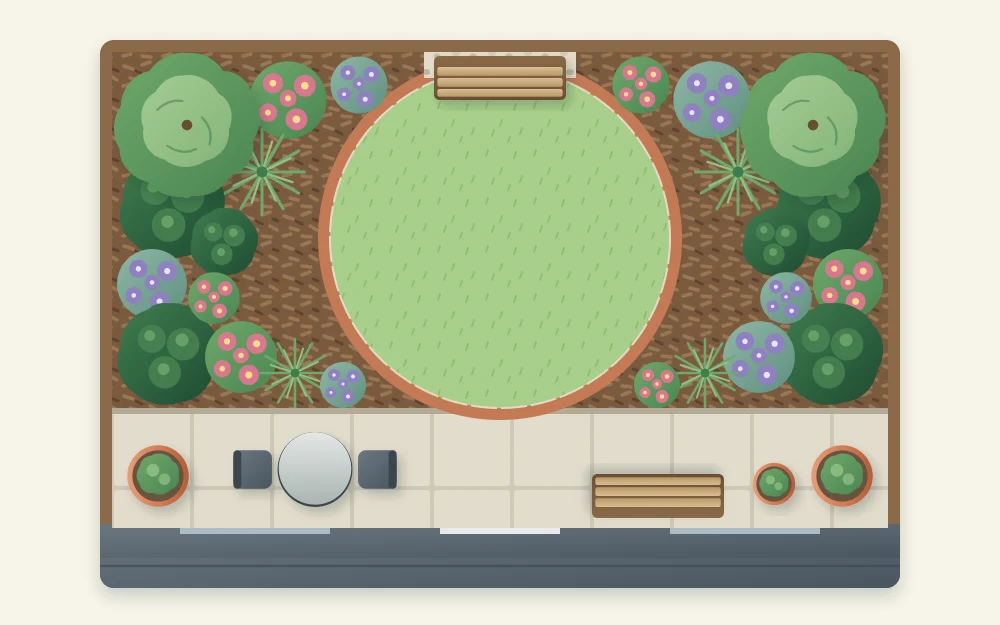
Planting goes around the edge and the middle stays open, paved or graveled. The open center gives the most usable floor for a table or for play, and the planted edge hides the boundary so the walls feel further away.
It suits enclosed, roughly square spaces. The risk is a thin, even strip of planting that looks like a frame around a box. Vary the depth of the beds and make at least one of them deep enough for layered planting.
6. The L-shaped layout
Planting, built-in seating or planters wrap two sides of one corner, forming an L that shelters a seating area. It gives a sense of enclosure without closing in the whole garden, and it places the seat where it looks out across the longest view.
Choose it when one corner clearly has the best light or the most privacy. Balance the opposite corner with a single strong element, such as a small tree or a large pot, so the garden does not feel weighted to one side.
A layout of two rooms
The seventh pattern splits the garden into two parts with a screen or a bed of taller planting that reaches partway across. You cannot see everything at once, and a space you have to walk into in order to see feels larger than one you take in at a glance.
It needs a rectangle long enough for each room to be useful on its own; two cramped halves are worse than one good whole. Offset the opening so you do not look straight through, and give each room a different job. The guide on dividing a small garden into zones explains how to size each part.
Good to know
A freestanding screen that stands on the ground is the simplest divider. Check it after wind, and before adding any screen near a boundary, check local rules and any HOA covenants.
The seven layouts compared
| Layout | Best plot shape | Feeling |
|---|---|---|
| Diagonal | Square, or short and wide | Dynamic, longer than it is |
| Circle or oval | Square (circle), rectangle (oval) | Soft, enclosed, calm |
| Offset rectangles | Long and narrow | Modern, wider than it is |
| Central path | Square or short rectangle | Formal, productive |
| Courtyard | Enclosed, roughly square | Open, sociable |
| L-shaped | Any plot with one good corner | Sheltered, relaxed |
| Two rooms | Longer rectangle | Intriguing, varied |
How to choose between them
Start from what you ranked first for the garden. If seating for several people matters most, the courtyard and L-shaped layouts give the largest clear floor. If growing matters most, the central path gives the most reachable bed. If the plot simply feels boxy, the diagonal and the circle do the most to disguise its shape.
Then test your favorite at full size. Mark the main shape on the ground with string or a hose, set out chairs where the seating would go and look at it from the back door and from an upstairs window. Adjust the drawing to match what you learn.
Pick one pattern and carry it through the whole garden. A diagonal patio beside a circular lawn beside a straight path gives three ideas competing in a space with room for one, and the single clear shape is what makes a small garden look planned.
Frequently asked questions
What is the best layout for a small square garden?
A diagonal layout or a central circle usually works well in a square plot, because both draw attention away from the four equal sides. The diagonal uses the longest line available, and the circle hides the corners behind planting. Sketch both on copies of your plan and compare the seating space each leaves.
Should a small garden have a lawn?
Only if you will use it. A small lawn gives a soft, open center and suits play, but it needs regular mowing and somewhere to keep a mower. Gravel or paving in the same shape gives a similar open feel. Decide by what you ranked first for the garden.
Can I combine two layout ideas in one small garden?
It is usually better to choose one. In a small space, two patterns compete and the result looks unplanned. The exception is a garden split into two rooms, where each part can have its own simple shape as long as the materials and plants repeat across both.