Small Garden Focal Point Ideas: Give the Eye a Place to Land
Why a small garden needs one main focal point, what it can be (a large pot, a bench, a birdbath, an obelisk or a small tree) and where to place it so the whole space feels organized.
Some small gardens have healthy plants, a tidy patio and a decent seat, and still feel shapeless. You look out and your eye wanders, finds nothing to settle on and comes back indoors. What is missing is usually not more planting. It is one clear thing to look at.
The small garden focal point ideas below explain what that one thing can be, where it should stand and why a small space is better with a single strong feature than with several modest ones.
What a focal point does
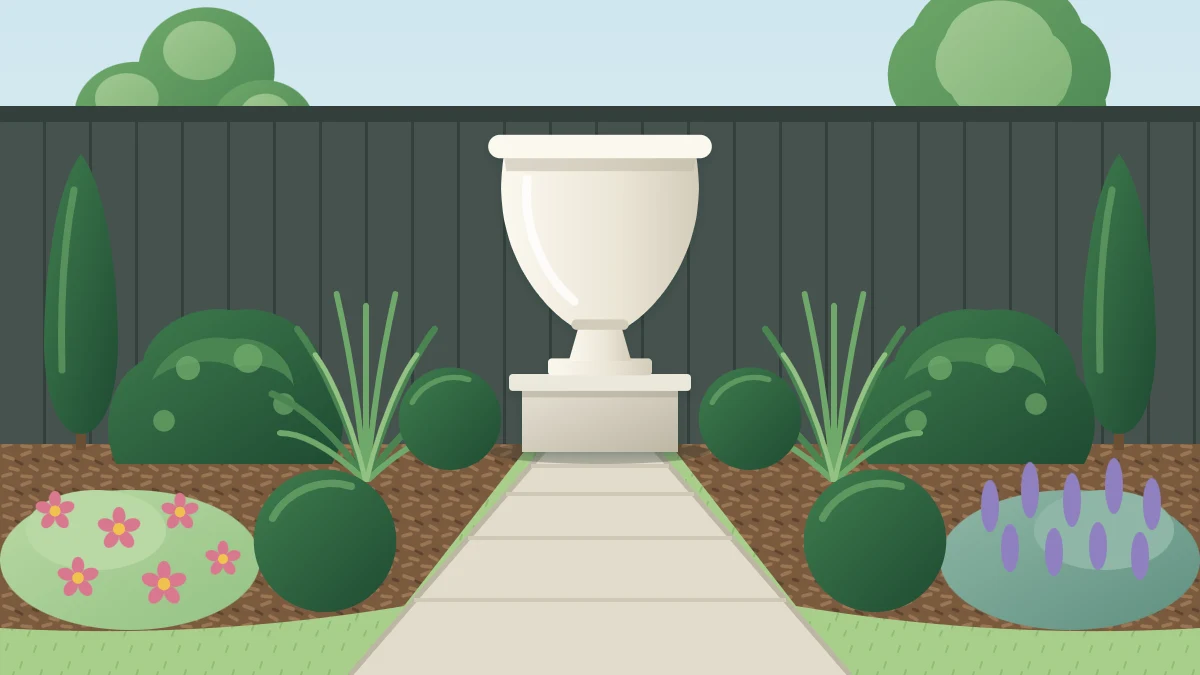
A focal point is the place the eye goes first and returns to. It gives a view a subject, the way a fireplace gives a living room one. Once the eye has somewhere to land, everything else, such as borders, paving and pots, reads as the setting for it, and the garden feels organized.
It also pulls the gaze through the space. A feature at the far end makes you look along the full length of the garden, which is one of the simplest ways to make a small garden look bigger.
Why one main focal point is enough
In a large garden each area can have its own feature, because you never see them all together. In a small garden nearly everything is in view at once. Three features seen in one glance compete, and the eye bounces between them without resting.
Choose one main focal point for the main view. A second, quieter one is fine only if it is hidden from the first, for example around the corner of a side passage or behind a screen.
Focal point options that suit small spaces
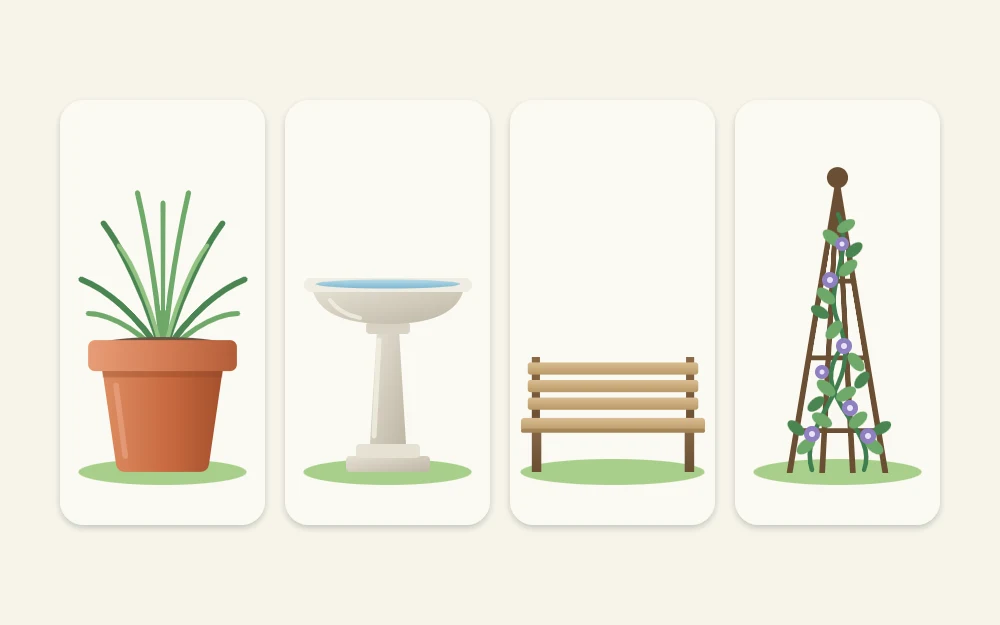
- A large pot or urn. It can be planted or left empty, and it is easy to move while you test positions. Its strong outline shows up against foliage.
- A specimen plant or small tree. A single plant with a distinct shape gives height and changes through the year. Japanese maple and serviceberry are widely grown examples; check that any choice suits your hardiness zone and read the mature height and spread on the label.
- A bench. A seat is a focal point with a purpose. It suggests a destination, so the eye and then the feet travel toward it.
- A water bowl or birdbath. Still water reflects the sky and brings light down to ground level, which helps in a shaded yard.
- A sculpture or found object. An old stone trough, a large rock or a weathered piece of metalwork can do the job as well as bought art. Simple shapes read best.
- An obelisk. A freestanding obelisk in a border adds a vertical accent from a small footprint and can carry a climber in summer.
- A painted door or panel. A bold block of color on a gate, a shed door or a freestanding panel draws the eye without using any floor area.
Where to put it
Placement matters more than the object. Start by finding your main sight line: the view from the back door, the kitchen window or the seat you use most. The focal point belongs at the far end of that line.
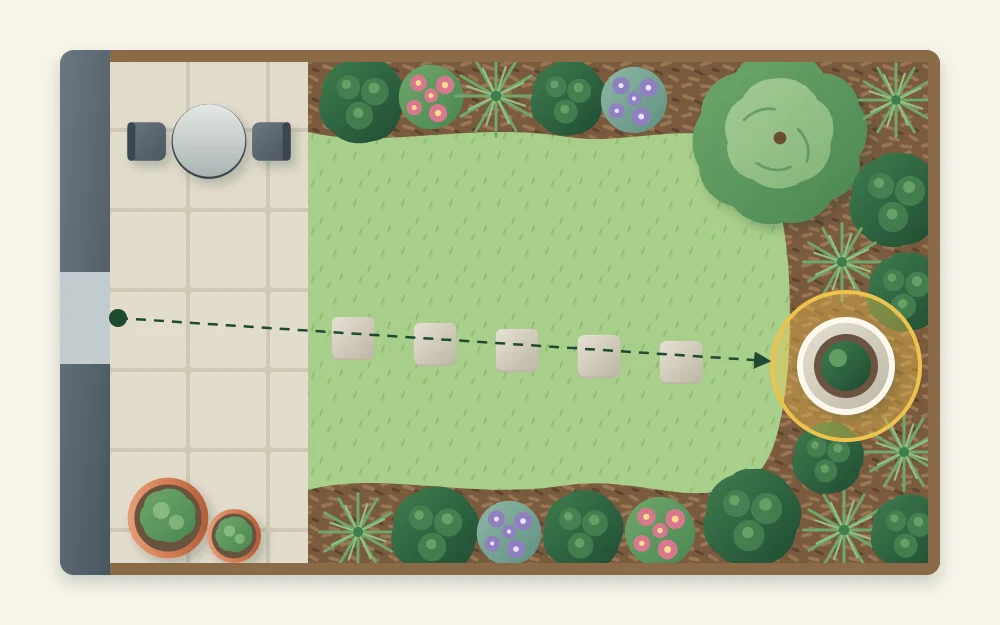
Three refinements make it work harder:
- Set it slightly off-center. A feature dead in the middle of the back boundary splits the garden into two equal halves and makes the plot look like a corridor. A little to one side, it draws the eye diagonally, across the longest dimension the garden has.
- Let a path lead to it. When a path or a line of paving ends at the feature, the layout and the view agree, and the garden makes sense at a glance.
- Frame it with planting. Taller plants on either side act like the edges of a picture, narrowing the view so the eye is steered to the right place.
For the design thinking behind emphasis and sight lines, see University of Florida IFAS Extension’s guide to the basic principles of landscape design.
Get the scale and the background right
The usual mistake in a small garden is choosing a small feature to match. A small object at the end of the view simply disappears. Scale it up: one generous pot, one bench, one substantial bowl. A big, simple shape makes the space feel confident.
Tip
Test the size before you buy. Stand a cardboard box or a stack of empty pots in the planned position and look at it from the house. If it is hard to pick out, go larger.
Then check what is behind it. A pale urn in front of a dark fence or a clipped evergreen stands out sharply. The same urn in front of mixed, busy planting gets lost. If the backdrop is cluttered, simplify it with one plain color or one kind of foliage.
Clear away the competition
A focal point works by contrast with calm surroundings. Small ornaments scattered through the beds, extra lanterns, wind chimes and a mix of little pots each ask for a share of attention, and together they cancel the main feature.
Take everything decorative out of the main view, place the focal point and then return only what supports it. Pots are the hardest to edit, so gather them into one or two tight groups; these container arrangement ideas show how to do that.
Good to know
If you want a mirror as your feature, read the cautions first. A mirror outdoors has to be made for outdoor use, kept out of direct sun and placed with birds in mind. The guide to using a garden mirror well covers each point.
Keep it working after dark and through the year
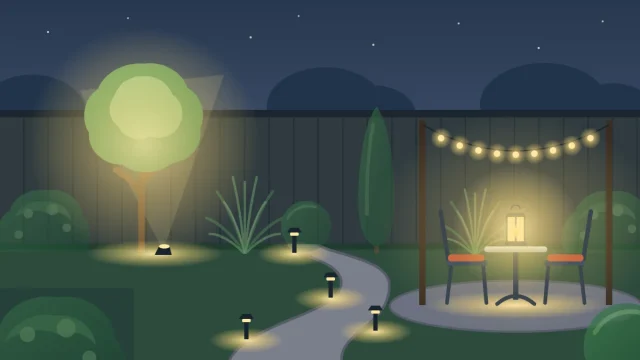
A focal point you can only see by day is doing half its job, since on many evenings the garden is seen mostly from indoors. One soft light aimed at the feature keeps the view alive at night; the guide to lighting a small garden explains how to do it without glare.
The position can stay fixed while the detail changes. Swap the planting in a large pot with the seasons and let the surroundings shift: bulbs at its base in spring, grasses around it in fall, a bare, strong outline in winter. The eye keeps its landing place, and the view still has something new in it.
Frequently asked questions
Can a plant be a focal point?
Yes, if it has a strong shape that reads from a distance, such as a small tree with a clear outline or a large architectural plant in a pot. It works best with simpler planting around it. Check that it suits your hardiness zone and look at the mature height and spread on the label.
Should a focal point be in the center of the garden?
Usually not in a small garden. A feature in the exact middle takes up the most useful open floor and divides the space in two. Placing it at the far end of the main view, a little to one side, draws the eye along the longest line and leaves the center free.
What if there is no clear view of the garden from the house?
Use the view from where you sit instead, or the view as you step through the gate or door. Any place you regularly pause is a viewpoint. Stand there, see where your eye naturally travels, and put the feature at the end of that line.