Year-Round Interest in a Small Garden: A Season-by-Season Plan
A simple grid method for finding the seasons when a small yard has nothing to offer, plus four rules for filling each gap without overcrowding the space.

Many small gardens have one glorious month. Everything flowers together in late spring or early summer, and then the border settles into plain green until the leaves drop. In a large garden you can walk to another area. In a small one, that single view is all there is.
Getting year-round interest in a small garden is less about buying more plants than about checking when each plant you already have does its work. A simple chart shows the empty seasons, and a few careful additions fill them.
Draw a season grid
You need a sheet of paper and about half an hour. The grid turns a vague feeling that the garden is dull in August into a clear list of gaps.
- List the main plants in the garden down the left side, one per row. Include trees, shrubs, climbers, perennials, grasses and bulbs. Leave out short-lived bedding.
- Draw four columns across the top for spring, summer, fall and winter.
- For each plant, mark the seasons when it adds something, and note what: flower, foliage, fruit or berries, bark or stems, or shape.
- Be honest. A shrub that flowers for two weeks and is plain green afterward gets one mark, not four.
- Read down each column. A column with few marks is a gap.

Find the gaps, then fill each with one plant
Most grids show the same pattern: a crowded late spring, a thin late summer and an almost empty winter. Resist the urge to fix every gap with a different plant. A small garden has room for only so many, and a border made of one of everything looks restless.
Instead, fill each gap with one plant that also does something in another season. A shrub with spring flowers and fall color covers two columns from a single space. A grass that looks fresh in summer and holds tan seed heads through winter covers three. The guide to the best plants for small gardens explains how to judge whether a plant earns its place.
Often the best fix is to repeat a hard-working plant you already have rather than introduce a new one.
What to look for in each season
Flowers are only one kind of interest, and they are the shortest-lived. Use this table as a prompt when you fill the gaps.
| Season | Kinds of interest | Where to find it |
|---|---|---|
| Spring | Bulbs, blossom, fresh new foliage | Bulbs under perennials, a small flowering tree, early perennials |
| Summer | Flowers, scent, full foliage texture | Long-flowering perennials, climbers near a seat, bold leaves |
| Fall | Leaf color, seed heads, fruit and berries | Shrubs and small trees that color well, grasses, late perennials |
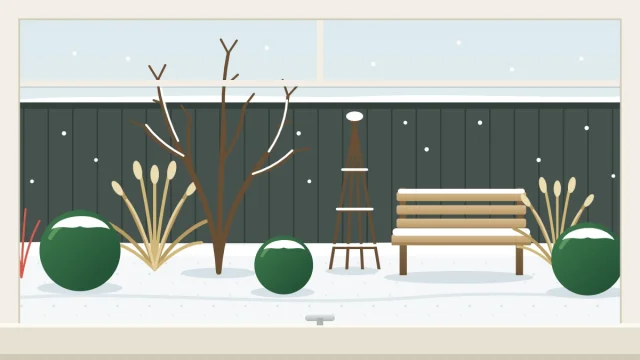
| Winter | Evergreen shape, bark, stems, outline | Structure plants, a tree with good bark, grasses left standing |
Spring and winter have their own guides: the spring refresh plan for a small garden covers getting the display started, and the guide to the small garden in winter covers designing for the bare months.
Four rules that suit small spaces
Keep about a third as evergreen structure
As a starting point, aim for at least a third of the planting to be structure plants: evergreen shapes that hold the design all year. They are the background in summer and the main event in winter. With too few, the garden vanishes when the perennials die back. With too many, it never changes. A third leaves room for the seasons to show.
Choose plants with two seasons of interest
Before any plant goes in, ask what it does when it is not in flower. Good foliage, fall color, berries, attractive bark or a strong shape all count. In a small space a plant with one short moment costs you the same ground as one that works for six months.
Layer bulbs under perennials
Bulbs let two seasons share one patch of soil. They flower in spring while the perennials around them are only starting, then the growing perennials hide the fading bulb leaves. This is the most space-efficient way to add a season, because it takes no extra room at all. Bulbs are planted in the fall for the following spring.
Keep one seasonal pot by the door
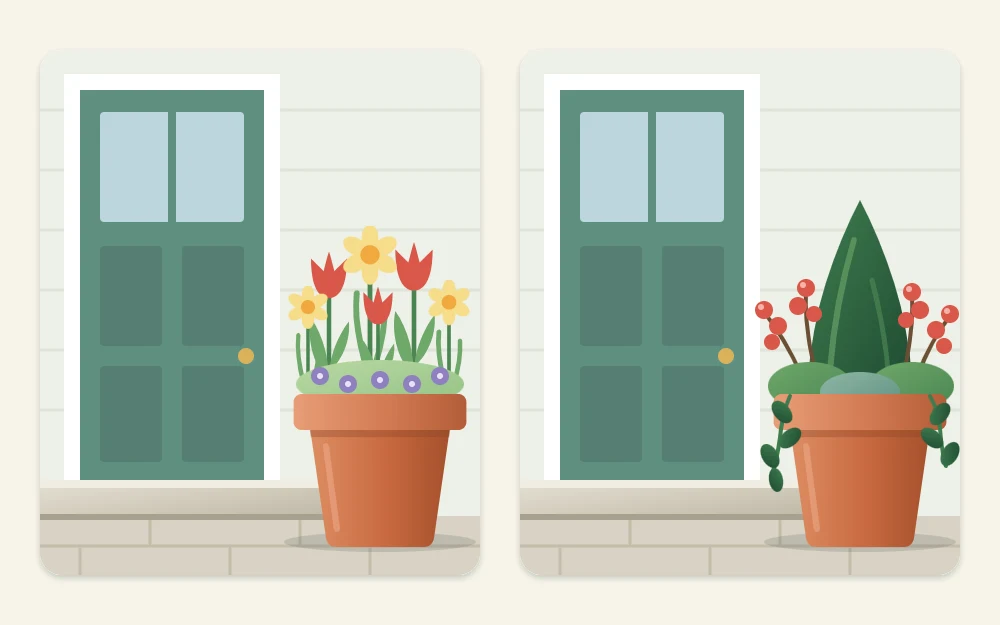
A single large pot beside the door, replanted through the year, puts the season where you pass it every day. Spring bulbs, summer flowers, fall foliage and then evergreens with berries give four changes from one position. One good pot does this better than several small ones, and it keeps the changing part of the garden to a place that is easy to reach.
Check choices against your zone
Seasons do not behave the same way everywhere. Fall color is reliable in some regions and brief in others, and a plant that is evergreen in a mild area may lose its leaves in a cold one. Before you buy, look up your zone on the USDA Plant Hardiness Zone Map and check that each plant suits it.
Good to know
Some shrubs sold for fall color or berries are invasive in parts of the US. Burning bush is a well-known example. Check your local invasive plant lists before buying, and read the mature height and spread on the label so the plant still fits in a few years.
Spread the interest across the view
When you fill the gaps, think about position as well as timing. If all the fall color sits in one corner, the rest of the garden still looks flat in October. Try to place each season’s plants in at least two or three spots, so the eye is drawn across the whole space.
Put the quiet seasons closest to the house. Winter and early spring interest is mostly seen through a window, so it belongs near the door or in the main sight line. Summer plants can sit farther away, because that is when you are outside to walk up to them.
Revisit the grid once a year
Plants grow, some fail and tastes change, so update the grid every winter when the gaps are easiest to see. Aim to add or swap one or two plants a year. A small garden improves fastest through a few considered changes, each chosen to fill a named gap, rather than through a trolley of impulse buys in May.
Frequently asked questions
How do I get color in a small garden all year?
Chart your main plants against the four seasons and mark when each one contributes. The empty columns show where to act. Fill each gap with a single plant that also offers something in another season, and count foliage, berries, bark and shape as well as flowers.
How much of a small garden should be evergreen?
A reasonable starting point is roughly a third of the planting. That gives enough permanent shape to hold the design through winter while leaving most of the space for plants that change with the seasons. Adjust the balance to suit your climate and how much winter view matters to you.
What is the easiest way to add another season of interest without more space?
Plant bulbs among existing perennials in the fall. They flower in spring before the perennials fill out, and the later growth covers their fading leaves, so two seasons share one patch of ground. A single large pot by the door, replanted through the year, is the other simple option.