Planter Box Ideas for Small Patios: Edges, Screens and Seats
Use planter boxes as space-shaping furniture: long low boxes to edge a patio, tall narrow ones as a green screen, an L around a corner seat, and boxes on casters you can rearrange.
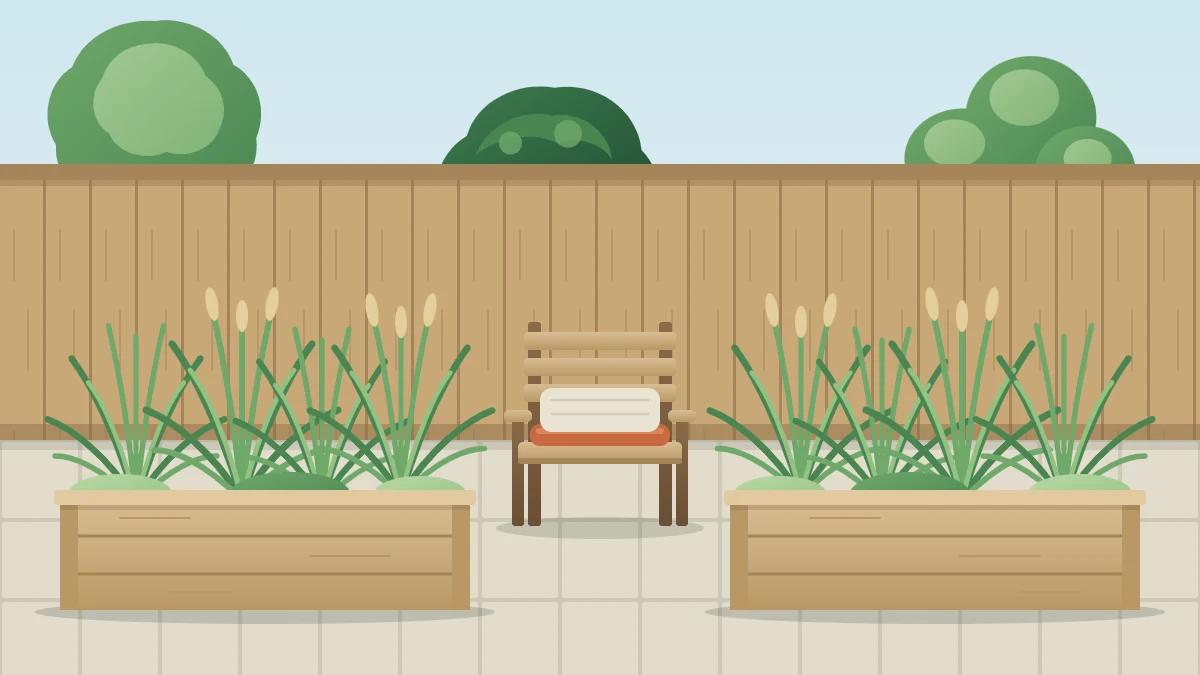
On a small patio, every object takes floor area, so each one should do more than a single job. A planter box is a good example. It holds plants, but it is also a low wall, a screen, an edge or the back of a seat, depending on its shape and where you put it.
These planter box ideas for small patios treat the box as a piece of space-shaping furniture. Each idea starts with the job the planter does in the layout, because that decides its height, length and position before any plant is chosen.
Decide the job before the box
Stand on the patio and ask what is missing. Common answers are an edge (the paving just runs out into the yard), enclosure (the seat feels exposed), privacy from one direction, or something green at eye level.
| What the patio needs | Planter shape | Where it goes |
|---|---|---|
| A clear edge | Long and low | Along the open side |
| Shelter or privacy | Tall and narrow | Between the seat and the view in |
| Somewhere to sit | Box with a seat edge or bench | Against a boundary or in a corner |
| Flexibility | Boxes on casters | Wherever the day requires |
Long, low boxes to draw an edge
A low planter along the open side of a patio marks where the sitting area ends. Because it stays below the eye line of someone seated, it defines the space without closing it in, and the view across the garden is kept.
Leave a gap in the line for an entrance. Two boxes with an opening between them make a doorway, and a doorway makes the patio feel like a room you enter. As a starting point, make the gap about 3 ft (roughly 90 cm) wide so two people can pass and a chair can be carried through.
The same move works inside a larger yard to separate one area from another. The guide on dividing a small garden into zones explains how to decide where those lines should fall.
Tall, narrow boxes as a green screen
When the need is privacy or shelter, turn the box on its end. A row of tall, slim planters with upright plants forms a screen that is only as deep as the box, which matters where floor area is short.
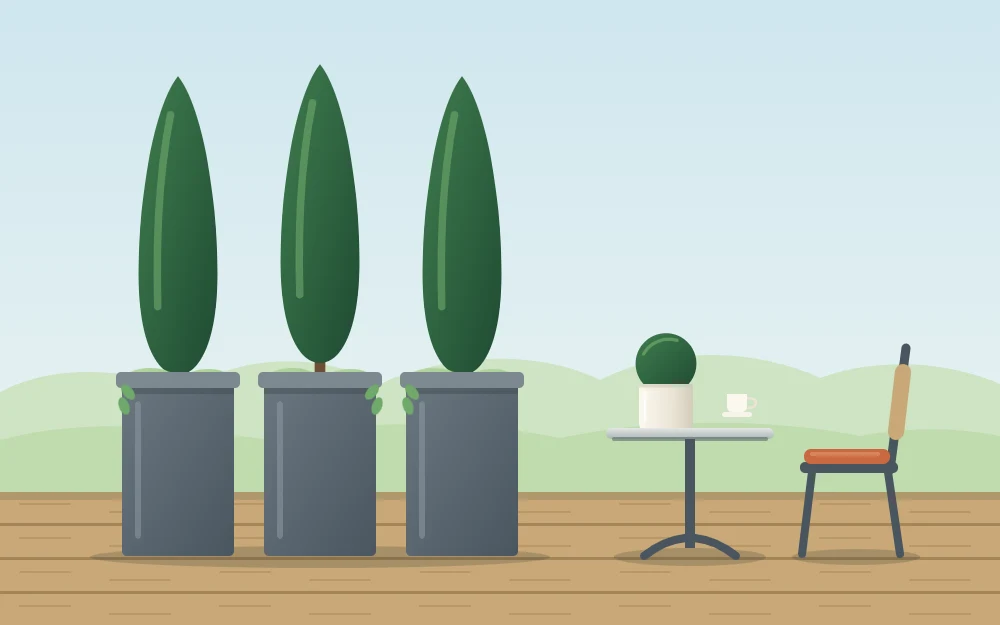
Place the screen close to the seat, not at the far boundary. A screen near the person being hidden blocks a wider angle of view, so it can be lower and shorter than one placed far away.
Upright grasses and narrow evergreens are typical choices, since they keep their shape for most of the year. Check that any plant suits your hardiness zone and read the mature height and spread on the label.
Good to know
Tall planters with tall plants catch the wind. Place them where they are sheltered, check them after wind, and check local rules and any HOA covenants before putting a tall screen near a boundary.
A planter with a seat edge
Some planter boxes are sold with a wide capped edge or an attached bench. On a small patio this replaces two or three chairs with one fixed piece along the boundary, and it frees the middle of the floor.
The planting behind the seat does the job a sofa back does indoors: it gives the sitter something behind them, which is a large part of why a seat feels comfortable. Use only units made as seating, and follow the manufacturer’s instructions for assembly and use.
An L of boxes to make a corner
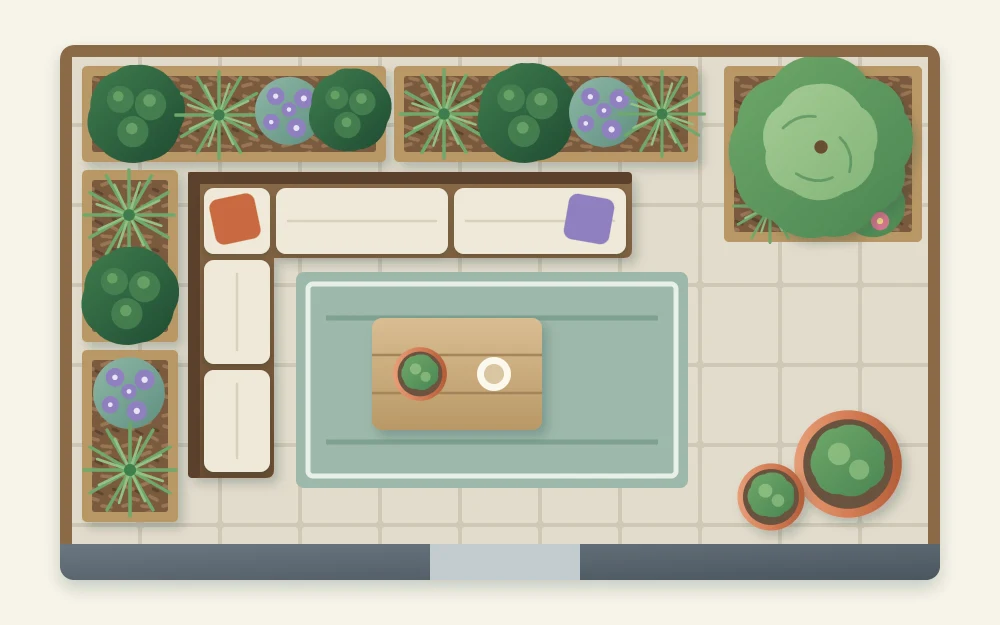
Two boxes set at a right angle wrap a corner and turn it into a destination. With a seat inside the L, the planting rises on two sides and the corner feels sheltered without a solid wall.
Boxes that move, repeat or climb
Boxes on casters
Planters bought with casters fitted let you change the layout: pushed apart for a gathering, pulled together as a screen for a quiet evening. They suit patios that have to serve as dining space one day and open floor the next. Lock the casters once the box is in position.
A matching line under a window
Two or three identical boxes on the ground beneath a window tie the house wall to the patio. Repetition is the point here, so keep the boxes, the spacing and the plants the same. Keep them low enough to stay below the sill, so the glass and the view out stay clear.
A planter with a built-in trellis
A freestanding box sold with its own trellis panel lets you grow a climber upward where there is no bed and nothing to attach to. It gives height from a small footprint and can stand in front of a plain fence without touching it. Assemble it as the manufacturer’s instructions describe and check it after wind.
Design choices that keep it calm
- One material, one color. Several boxes in the same finish read as built-in structure. Mixed finishes read as extra furniture, and the patio looks fuller.
- Height in scale with the seating. A box about level with the chair seat marks an edge; one near the height of a seated person’s head gives enclosure. Anything between tends to do neither job well.
- Gaps for access. Leave openings to reach the yard, the gate and the hose. A continuous line of boxes turns a patio into a pen.
- Plants for year-round shape. Grasses and evergreens work as structure plants, so the box still does its job when flowers have finished.
Tip
Before buying, mark the footprint of each box on the paving with chalk or flattened cardboard. Live with it for a few days and see whether you still walk and sit comfortably.
Fit the boxes around the rest of the patio
Planter boxes are the large, straight pieces of a patio layout. Round pots are the accents. Set the boxes first, then add one group of pots where a corner or the end of a box needs softening; these container arrangement ideas show how to compose that group.
If the patio itself is still being planned, start with seating and routes and let the planters follow. The guide to laying out a tiny patio garden covers that order of decisions.
Frequently asked questions
How tall should a planter box be for privacy on a patio?
It depends on where it stands. A planter placed close to the seat can be lower, because it blocks a wider angle of view from there. Sit in the chair, have someone hold a cane at different heights, and note the height at which the view in is hidden. Check local rules before adding a tall screen.
Should planter boxes match the patio furniture?
They do not need to match exactly, but they should share something: a color, a material or a line. What matters more is that the planters match each other. Several boxes in one finish look like part of the patio's structure and leave the furniture as the only separate items.
Is it better to buy planter boxes or have them built?
Either can work. Bought boxes come in set sizes and can be moved or taken with you. Boxes made to measure by a carpenter or landscaper fit an awkward length exactly. Decide the job, height and length first, then see whether a standard size does it.

