How to Group Pots: A Simple Three-Pot Arrangement
A step-by-step way to compose one good-looking pot group for a corner or doorway: choose three sizes in one material, pick three plant shapes and place them as an uneven triangle.
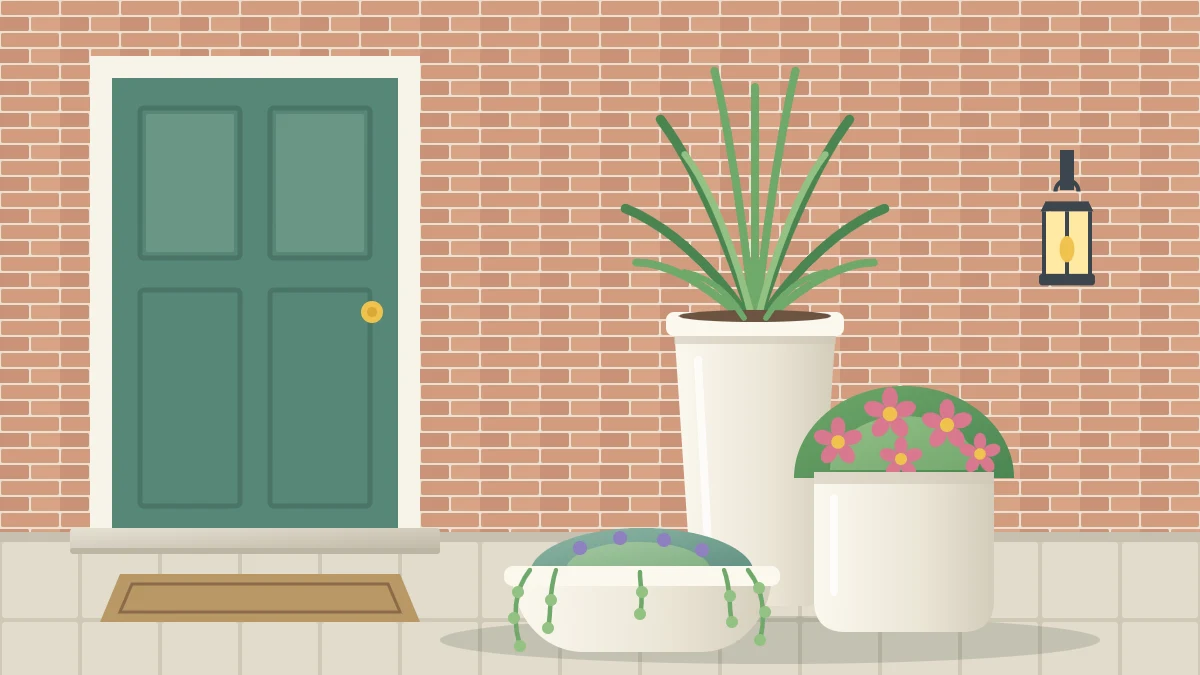
Project at a glance
What you need
- Three pots in one material: tall, medium and low
- One upright plant
- One mounding plant
- One trailing or low plant
- Outdoor pot stand or spare upturned pot
- Wheeled pot mover (optional)
Three pots, placed well, can finish a corner or a doorway better than a dozen placed at random. The difference is composition: which pot goes where, how much they overlap, and where you stand to judge them.
This tutorial shows how to group pots into one simple arrangement you can build in an afternoon. It deals with choosing and placing, not planting, so you can follow it with pots that are already planted or with empty ones you plan to fill later.
Why three pots work
Three objects of different sizes make an uneven triangle, and an uneven triangle gives the eye a path: up to the tallest point, down across the middle and out to the lowest edge. Two pots look like a pair that is missing its symmetry. Four tend to line up into a row or a square.
Three is also a small enough number to carry around and reposition until it looks right, which is most of the work.
Choose the three pots
Pick pots in one material and one color, in three clearly different sizes. Matching the finish makes the group read as a set; varying the size gives it an outline.
| Pot | Shape to look for | Its job in the group |
|---|---|---|
| Tall | Upright, taller than it is wide | Sets the high point and the backdrop |
| Medium | About two thirds of the tall pot’s height | Links the high point to the ground |
| Low | A bowl, wider than it is tall | Spreads the group forward and anchors it |
The two-thirds figure is a rough guide, not a rule. What matters is that nobody could mistake one size for another. If two pots look nearly the same height, the group goes flat.
Choose three plant shapes
The plants should repeat the idea of the pots: three different outlines that stack into one shape.
- One upright for the tall pot, such as an ornamental grass or a narrow evergreen.
- One mounding for the medium pot: a rounded, bushy plant that fills out to the rim.
- One trailing or low for the bowl, something that spills over the edge or forms a flat carpet.
Keep the color range narrow. Mostly green with one flower color is easier to live with than three competing colors. Choose plants that want the same amount of sun, check that each suits your hardiness zone, and read the mature height and spread on the label so the upright one stays the tallest.
Find the main viewpoint first
Before you move anything, decide where the group will mostly be seen from. It might be the back door, the kitchen window or your usual chair. Stand or sit there and look at the spot.
Everything in the steps below is judged from that place. A group arranged while you are standing over it often looks lopsided from the house, because “back” and “front” were set from the wrong direction.
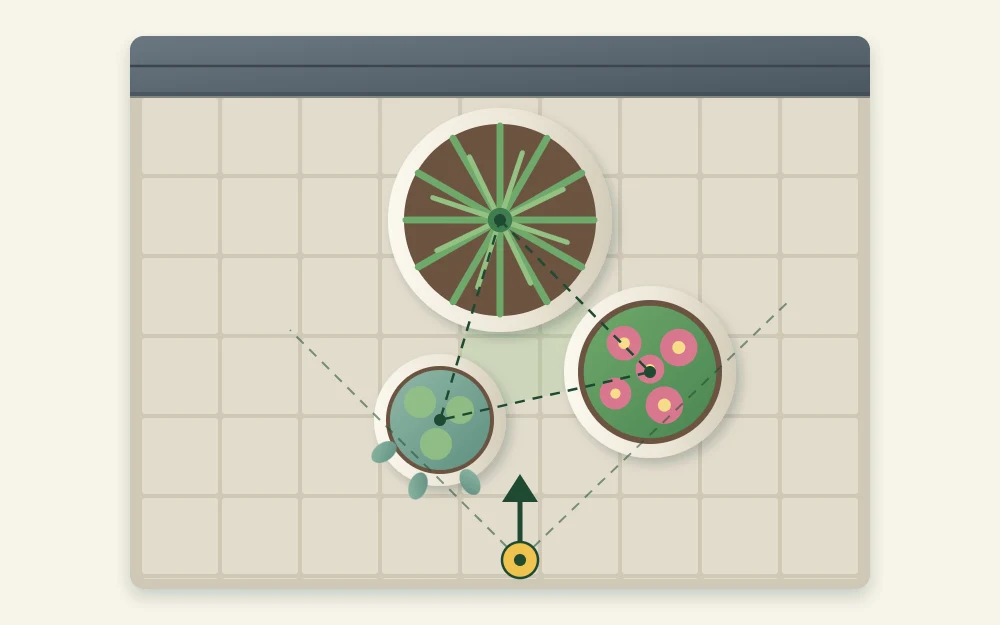
Place the pots, one at a time
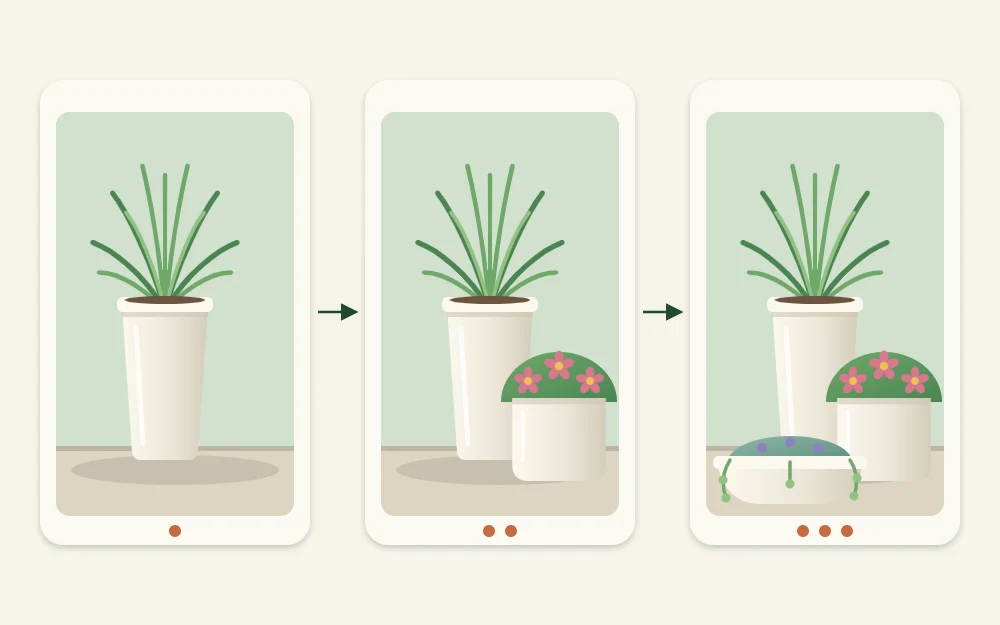
- Set the tallest pot at the back, off-center. Put it against the wall, fence or corner, a little to the left or right of the middle of the space. Off-center placing leaves room for the group to grow to one side.
- Add the medium pot forward and to one side. Move it until, from your main viewpoint, it overlaps the tall pot by about a third. The overlap is what joins two objects into one shape.
- Place the low pot in front to complete the triangle. Set it on the open side, forward of the other two, so the three pots form a triangle with no two sides the same length.
- Close the gaps. Slide the pots until they touch or nearly touch. Space between them breaks the group apart.
- Check the heights. If the medium and tall pots look too similar once planted, raise the tall one on a pot stand made for outdoor use or on an upturned empty pot.
- Step back and adjust. Return to the main viewpoint. Nudge one pot at a time and look again. Small moves of a few inches (several centimeters) change the outline more than you expect.
- Turn each plant’s best side forward. Rotate every pot so the fullest side faces the viewpoint and any thin side faces the wall.
Tip
Arrange the pots empty or before watering if you can, since they are far easier to shift. For a large planted pot, a wheeled pot mover saves lifting.
Adapt it for five pots or a narrow doorway
Five pots
Build the three-pot triangle first, then add two more low or medium pots, one tucked into each lower corner. Keep one clear high point. If the fourth and fifth pots are as tall as the first, the outline turns into a wall. For more ways to use larger groups, lines and pairs, see these ideas for arranging containers across the whole garden.
A narrow doorway
Beside a door there is rarely depth for a triangle. Flatten it: put all three pots on one side of the door, stepped down in height away from the frame, each slightly in front of the last. Use slimmer pots and keep the group to the hinge side or the wall side, wherever the door does not swing.
A corner
In a corner the tall pot goes right into the angle and the others fan out along both sides. This is one of several ways to make use of an awkward garden corner.
Keep the route clear
A pot group that narrows a walkway becomes an obstacle, however good it looks. As a starting point, leave a clear path of about 3 ft (roughly 90 cm) past the group, and more beside a door that is used with full hands.
Good to know
Check a raised pot after wind and after anyone has knocked it, and keep raised pots away from the edge of steps and the swing of doors and gates.
On a very small patio, one well-placed group is usually enough. The guide to planning a tiny patio garden shows how a pot group fits around seating without using up the floor.
Frequently asked questions
Can I group pots that are different colors?
You can, but it is harder to make them look like one arrangement. If the colors differ, keep the material and shape the same, or choose colors from one family such as three shades of blue. The more the pots differ, the simpler and more alike the plants in them should be.
How close together should grouped pots be?
Close enough to read as one shape, which usually means touching or almost touching at the widest point. From the main viewpoint the pots should overlap a little. If you can see a clear strip of paving between two pots, slide them together until it disappears.
What if all my pots are the same height?
Create the height difference another way. Raise one pot on an outdoor pot stand or an upturned empty pot, and use plants of very different heights: a tall upright plant in the raised pot and a low or trailing one in the front pot. Check the raised pot after wind.

